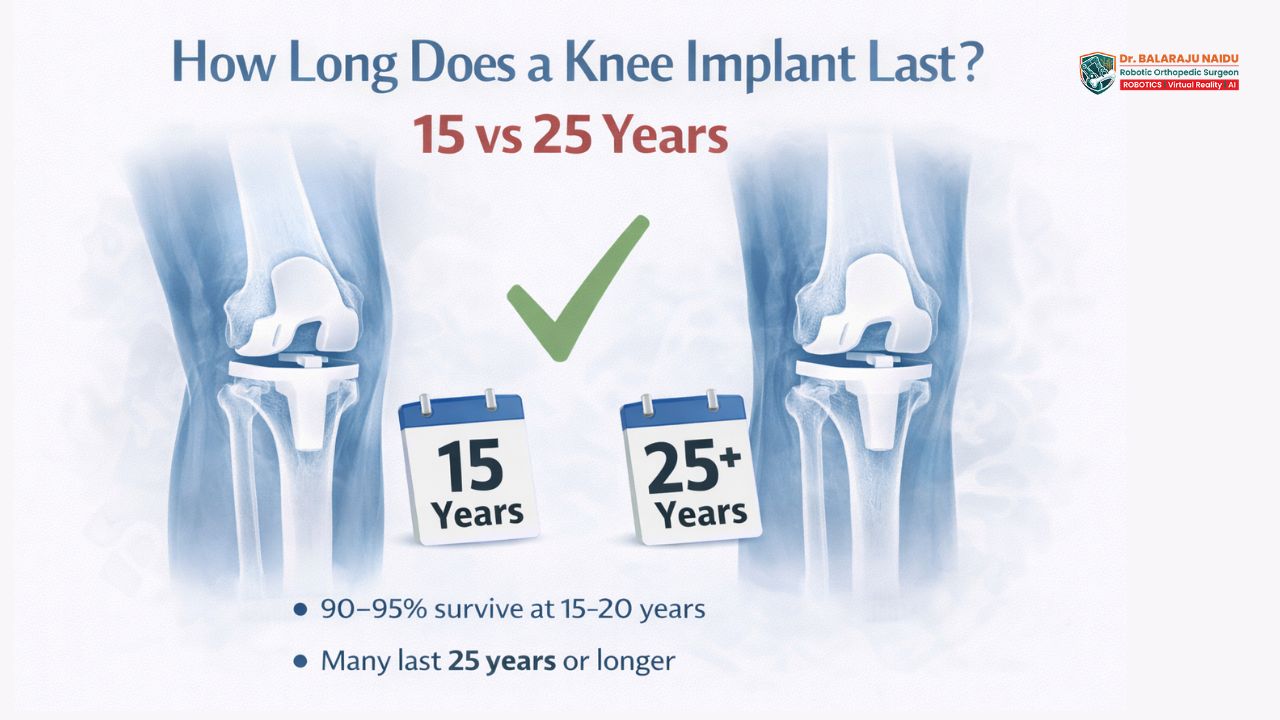
How Long Does a Knee Implant Last? 15 vs 25 Years Explained – By Dr. Balaraju Naidu, Robotic Orthopedic Surgeon, ONUS Robotic Hospitals
Knee replacement surgery has dramatically improved the quality of life for patients suffering from severe knee arthritis. One of the most common questions patients ask before surgery is:
“How long will my knee implant last?”
For many years, people believed that knee implants last only 10–15 years. This perception came from early implant designs and older surgical techniques.
However, modern research shows a very different picture.
Understanding Knee Replacement Implants
During a Total knee replacement, the damaged surfaces of the knee joint are replaced with artificial components made from metal alloys, polyethylene, and advanced biomaterials.
These implants are designed to:
Restore smooth joint movement
Reduce pain caused by arthritis
Improve mobility and quality of life
Modern implants are engineered for long-term durability and wear resistance.
What Do Current Studies Show?
Recent registry data and long-term studies demonstrate excellent implant survival rates.
Research from international joint registries shows:
90–95% implant survival at 15–20 years
Many implants functioning well beyond 25 years
Improved durability due to better materials and surgical precision
Advances such as improved polyethylene, better fixation techniques, and robotic-assisted surgery have significantly enhanced implant longevity.
Why Modern Knee Implants Last Longer
Several advancements have improved outcomes over the last two decades.
1️⃣ Advanced Implant Materials
Modern implants use highly cross-linked polyethylene, cobalt-chromium alloys, and titanium components that resist wear.
2️⃣ Improved Surgical Techniques
Better alignment and soft tissue balancing improve load distribution across the joint.
3️⃣ Robotic-Assisted Surgery
Robotic systems help surgeons achieve precise implant positioning and reduce alignment errors.
4️⃣ Better Patient Selection
Improved understanding of patient factors leads to more individualized treatment planning.
These improvements contribute to longer implant survival.
Factors That Affect Implant Longevity
Even the best implant depends on several patient and surgical factors.
1️⃣ Implant Positioning Accuracy
Proper alignment ensures even load distribution and reduces wear.
2️⃣ Body Weight
Excess weight increases stress on the knee joint.
3️⃣ Activity Intensity
High-impact activities can accelerate implant wear.
4️⃣ Infection
Joint infection remains one of the most serious complications affecting implant survival.
5️⃣ Bone Quality
Strong bone support improves implant stability.
A combination of surgical precision and patient lifestyle plays a major role in implant longevity.
Can Knee Implants Last a Lifetime?
For many patients, the answer is yes.
Patients who undergo knee replacement after age 60 often have implants that last for the remainder of their life.
However, younger patients have a slightly higher chance of needing revision surgery simply because they live longer and place more years of stress on the implant.
What Is Revision Knee Replacement?
Revision surgery refers to replacing or repairing a previously implanted artificial joint.
Advances in implant durability have significantly reduced the need for revision surgery compared with earlier decades.
Maintaining a healthy lifestyle helps delay or avoid revision procedures.
Tips to Make Your Knee Implant Last Longer
Patients can significantly influence implant longevity by following simple precautions.
✔ Maintain a healthy body weight
✔ Perform strengthening exercises regularly
✔ Avoid high-impact sports like running or jumping
✔ Follow physiotherapy recommendations
✔ Attend regular orthopedic follow-ups
Protecting the implant ensures long-term success.
Final Verdict
Modern knee implants are designed for long-term durability.
With:
Accurate surgical technique
Advanced implant materials
Proper rehabilitation
Healthy lifestyle habits
Many knee replacements can function well for 20–25 years or longer.
For many patients, especially those undergoing surgery after 60 years of age, the implant may last for the rest of their life.
Knee replacement is not just about replacing a joint — it is about restoring mobility and improving quality of life.
For Appointments:
Dr. Balaraju Naidu, Robotic Orthopedic Surgeon
ONUS Robotic Hospitals – Hyderabad
👉 link: contact-us or book-appointment