

Computer-Navigated Hip Replacement
Computer-Navigated Hip Replacement
Overview
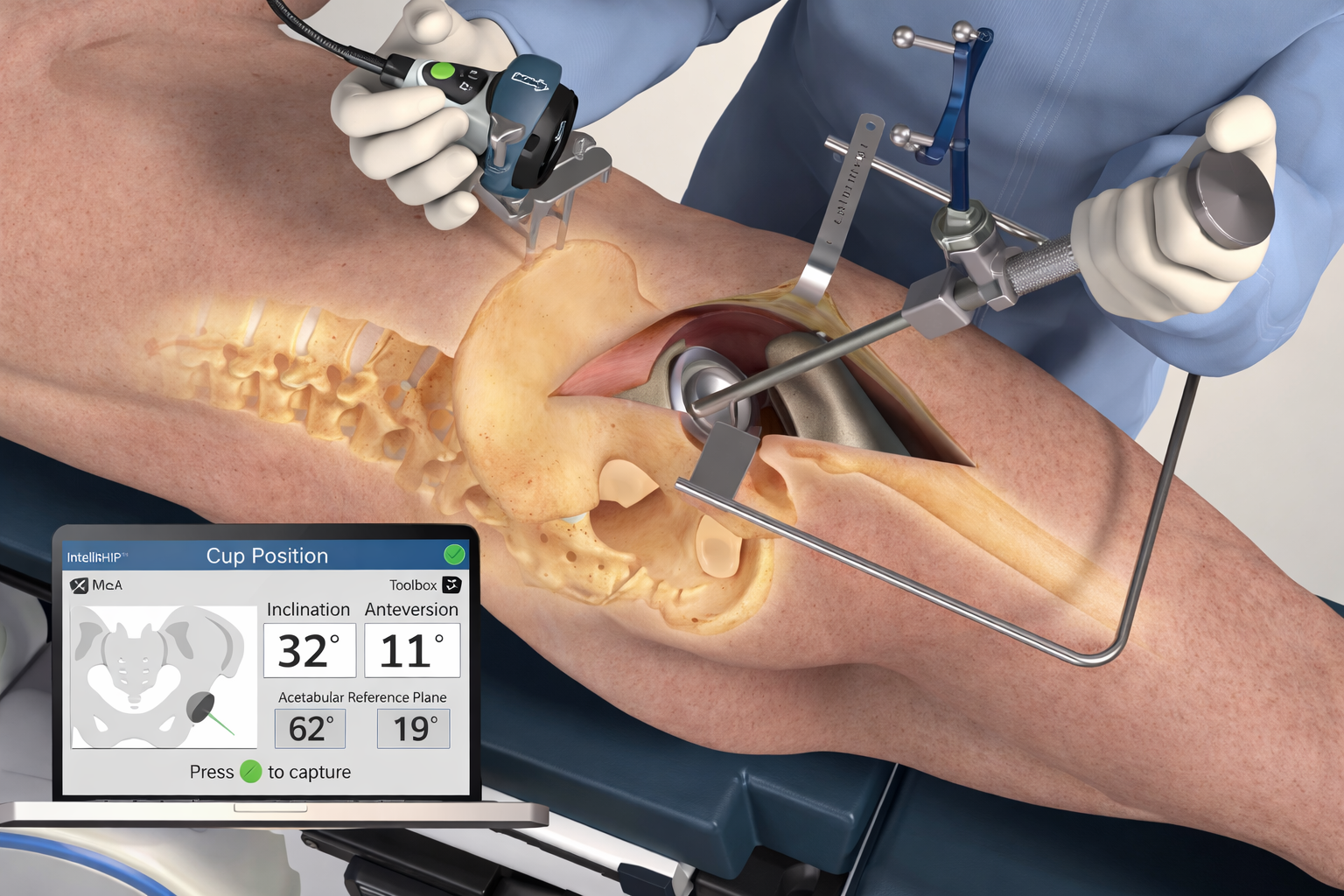
Computer-Navigated Hip Replacement is an advanced, technology-driven hip replacement technique that uses real-time digital navigation to achieve highly accurate implant positioning and optimal hip biomechanics—without the use of a robotic arm. This approach is particularly valuable in young patients and complex hip conditions, where precision today determines function and implant longevity for decades.
With international training in navigation and joint replacement surgery, Dr. Balaraju Naidu applies computer navigation to restore natural hip mechanics, ensure accurate cup orientation, and minimize long-term complications.
What Is Computer-Navigated Hip Replacement?
In navigation-guided hip replacement, a computer system continuously tracks the position of the pelvis, femur, and surgical instruments during surgery. The system provides real-time visual feedback to the surgeon, enabling precise execution of every step.
Navigation technology helps by:
Creating a digital reference of pelvic and femoral anatomy
Guiding accurate acetabular cup orientation
Ensuring correct anteversion and inclination angles
Restoring leg length and hip offset
Verifying stability and range of motion intraoperatively
The surgeon remains in full control, with navigation acting as a precision enhancement tool.
Who Benefits from Computer-Navigated Hip Replacement?
Indications
This technique is especially recommended for:
Young and active patients requiring long implant survival
Complex hip anatomy
Developmental dysplasia of the hip (DDH)
Post-traumatic hip arthritis
Avascular necrosis with altered anatomy
Obese patients where landmarks are difficult
Patients with spinal deformities affecting pelvic tilt
Cases where accurate leg-length restoration is critical
Navigation is particularly useful when anatomical landmarks are unreliable.
Benefits of Navigation-Guided Hip Replacement
✅ Accurate acetabular cup positioning
✅ Optimized hip biomechanics
✅ Better leg-length equality
✅ Reduced risk of dislocation
✅ Lower abnormal implant wear
✅ Improved joint stability and movement
✅ Enhanced long-term implant survival
✅ Excellent outcomes in complex hips
Correct component orientation is one of the most important predictors of long-term success in hip replacement.
Expertise of Dr. Balaraju Naidu
Dr. Balaraju Naidu’s extensive experience in computer navigation, robotic joint replacement, and complex hip surgery allows him to select the most appropriate technology for each patient.
His expertise includes:
Precision acetabular cup alignment
Accurate restoration of leg length and offset
Managing complex and dysplastic hips
Treating young patients with long-term functional goals
Combining navigation with minimally invasive techniques
This ensures predictable outcomes, durability, and natural hip function.
Procedure: Step-by-Step
Preoperative Planning
Clinical evaluation and imaging to understand hip anatomy and biomechanics.Navigation Setup
Sensors are placed to track pelvic and femoral movement during surgery.Navigation-Guided Implant Placement
Real-time feedback guides accurate bone preparation and component orientation.Verification & Stability Assessment
Hip stability, leg length, and range of motion are digitally confirmed before closure.
Recovery After Computer-Navigated Hip Replacement
Standing and walking usually begin within 24 hours
Hospital stay typically 2–3 days
Faster functional recovery due to accurate biomechanics
Structured physiotherapy for strength and mobility
Return to routine activities within 3–6 weeks
Long-term improvement in comfort, gait, and confidence
Why Choose Computer-Navigated Hip Replacement?
Ideal for young and complex hip cases
Improves precision over conventional techniques
Reduces long-term complications
Surgeon-controlled, technology-assisted accuracy
Focus on biomechanics and implant longevity