

Revision Hip Replacement
Revision Hip Replacement
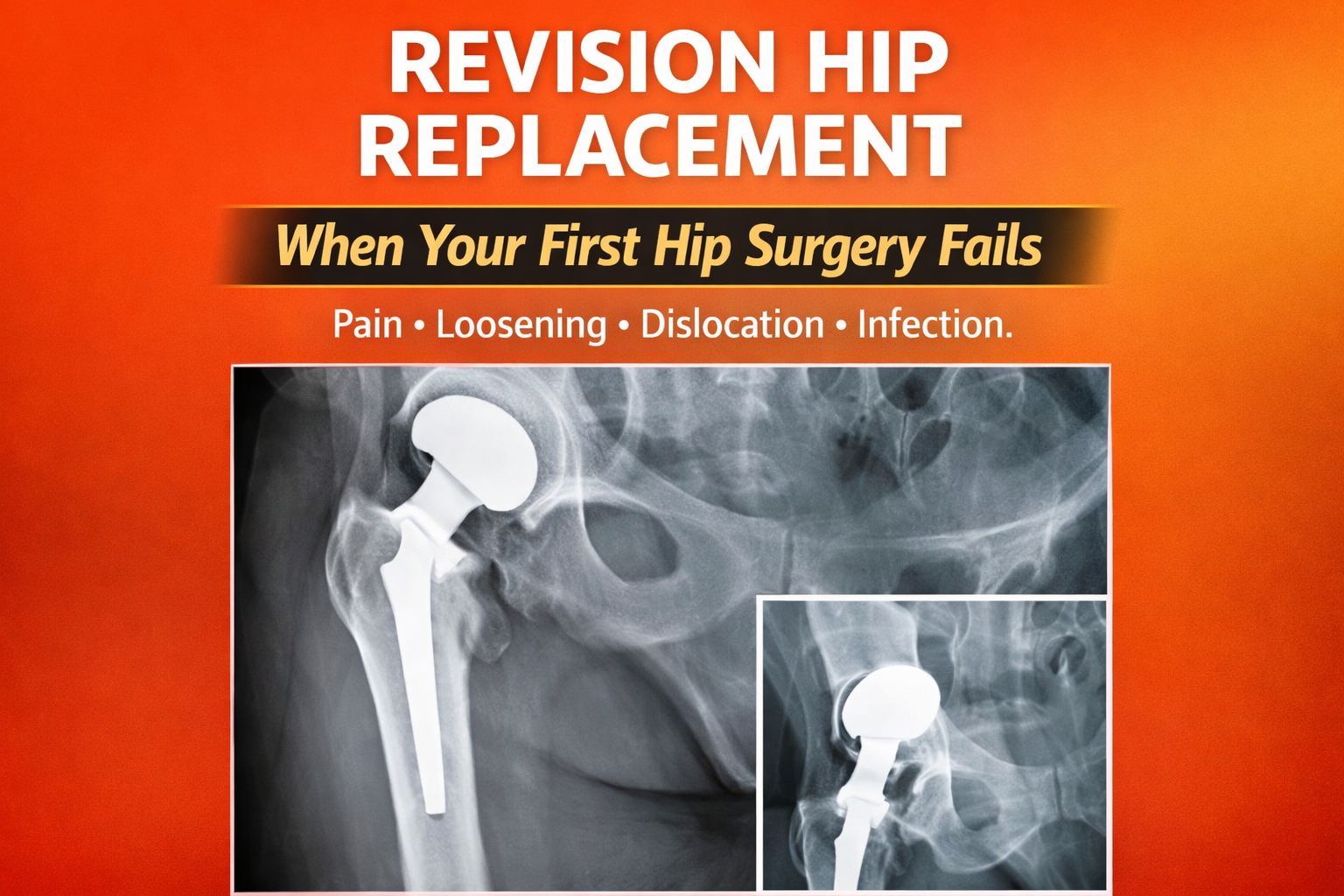
Overview
Revision Hip Replacement is a highly advanced re-replacement surgery performed when a previously implanted artificial hip joint fails to function properly. This may occur due to implant wear, loosening, recurrent dislocation, infection, or mechanical failure. Revision hip replacement is far more complex than primary hip replacement and demands specialized expertise, advanced implants, and meticulous surgical planning.
With European fellowship training in hip replacement and complex revision techniques, Dr. Balaraju Naidu specializes in restoring stability, function, and durability in failed hip replacements—often in cases where patients are told surgery is high risk or not possible.
What Is Revision Hip Replacement?
Revision hip replacement involves removing part or all of the failed hip implant and replacing it with a new, specially designed revision prosthesis. These implants may include long stems, modular components, augments, liners, or custom solutions to address bone loss and instability.
Revision surgery may be:
Partial revision – replacing only the worn or failed component
Complete revision – replacing both cup and stem
Staged revision – commonly used in infected hip replacements
Each revision is uniquely planned based on the cause of failure and bone condition.
When Is Revision Hip Replacement Required?
Indications
Revision hip replacement is indicated for:
Recurrent hip dislocation
Implant loosening (aseptic loosening)
Excessive implant wear
Infection after hip replacement
Persistent or worsening hip pain
Implant breakage or malposition
Peri-prosthetic fractures (fracture around implant)
Failed previous revision surgery
Leg-length discrepancy after hip replacement
Early intervention helps prevent further bone loss and complications.
Challenges in Revision Hip Replacement
Revision hip replacement is technically demanding due to:
Significant bone loss in the pelvis or femur
Scar tissue and muscle damage
Distorted anatomy
Infection eradication requirements
Poor bone quality
Higher risk of instability and dislocation
Success depends heavily on surgeon experience and infrastructure.
Benefits of Revision Hip Replacement
✅ Relief from chronic hip pain
✅ Improved joint stability
✅ Restoration of mobility and walking ability
✅ Correction of leg-length discrepancy
✅ Elimination or control of infection
✅ Improved quality of life
✅ Prevention of further joint damage
When performed by an experienced specialist, revision surgery can provide durable and life-changing results.
Surgical Expertise of Dr. Balaraju Naidu
With multiple European fellowships in hip replacement, computer navigation, and complex reconstruction, Dr. Balaraju Naidu is trained in managing the most challenging revision hip cases.
Expertise includes:
Advanced bone loss management (augments, cages, modular stems)
Infection management (single-stage & two-stage revisions)
Stability-focused implant selection
Managing recurrent dislocations
Computer navigation assistance for accurate orientation
Revision surgery after multiple failed implants
This expertise ensures precision, safety, and long-term implant survival.
Procedure: Step-by-Step
Comprehensive Evaluation
Detailed imaging, blood tests, and infection workup to identify failure cause.Surgical Planning
Customized implant and reconstruction strategy based on bone loss and stability.Revision Surgery
Removal of failed implant, bone reconstruction, and placement of revision prosthesis.Verification & Stability Assessment
Implant fixation, leg length, and hip stability are confirmed intraoperatively.
Recovery After Revision Hip Replacement
Hospital stay typically 3–5 days
Gradual mobilization with physiotherapy
Recovery may take longer than primary hip replacement
Pain relief improves steadily over weeks
Rehabilitation tailored to complexity of surgery
Most patients regain functional independence and walking ability
Why Choose a Revision Hip Replacement Specialist?
Revision hip replacement requires a dedicated revision arthroplasty specialist due to its complexity.
Choosing an expert ensures:
Correct identification of implant failure
Proper implant and reconstruction strategy
Effective management of bone loss and infection
Reduced risk of repeat failure
Better long-term outcomes