

Bone Loss Management in Revision Arthroplasty
Bone Loss Management in Revision Arthroplasty
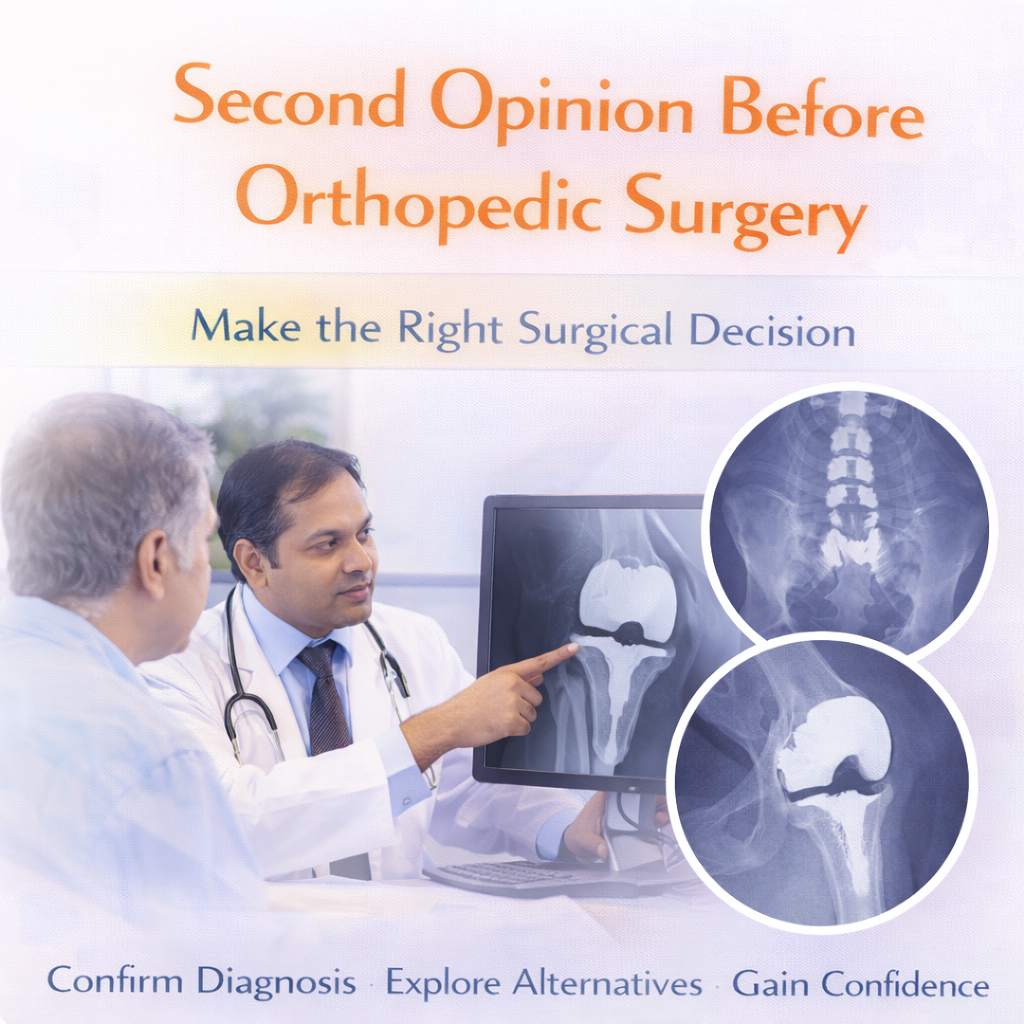
Overview
A Second Opinion Before Orthopedic Surgery allows patients to confirm diagnosis, explore alternative treatments, and ensure that surgery is truly necessary. Orthopedic procedures such as joint replacement, spine surgery, or ligament reconstruction are major decisions — and getting a second expert review can provide clarity and confidence.
Seeking a second opinion is not a sign of doubt — it is a smart and informed healthcare decision.
Why Consider a Second Opinion?
You should consider a second opinion if:
Surgery has been advised immediately
You are unsure about diagnosis
Conservative treatment options were not discussed
Complex revision surgery is suggested
You have persistent pain despite previous surgery
You want clarity about risks and outcomes
Major surgery should always be well understood before proceeding.
What Does a Second Opinion Include?
Detailed clinical evaluation
Review of X-rays, MRI, CT scans
Assessment of previous treatment
Discussion of non-surgical options
Risk-benefit explanation
Surgical alternatives if required
The goal is to provide transparent, evidence-based guidance.
Benefits of a Second Opinion
✅ Confirms correct diagnosis
✅ Avoids unnecessary surgery
✅ Explores non-surgical options
✅ Improves treatment confidence
✅ Clarifies expectations
✅ Ensures best surgical approach
Patients feel empowered and better informed.
When Is It Most Important?
Joint replacement recommended at young age
Complex spine surgery advised
Revision surgery planned
High-risk medical condition
Multiple surgical options available
In complex cases, expertise matters significantly.
Final Thought
Orthopedic surgery is a life-changing decision. A structured second opinion ensures that the right surgery — at the right time — for the right reason is chosen.