

Cartilage Restoration Procedures
Cartilage Restoration Procedures
Overview
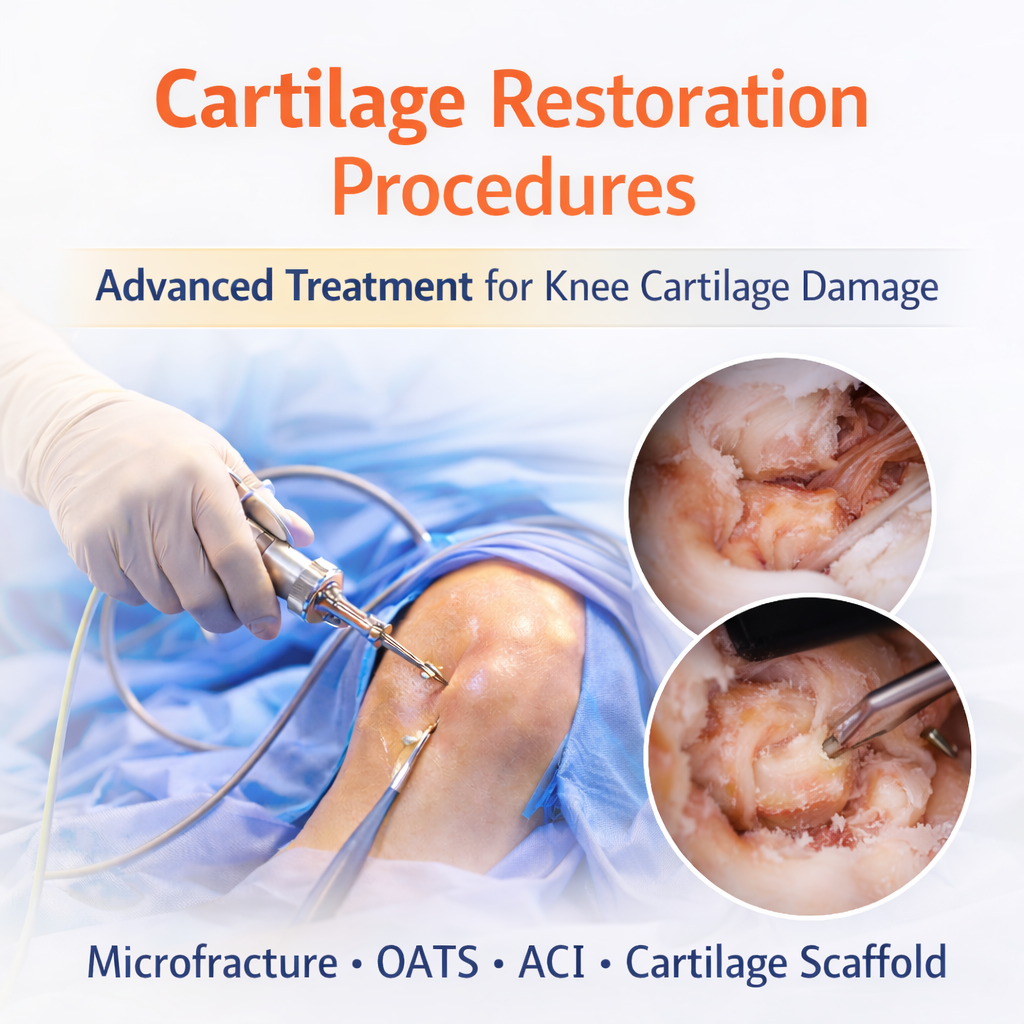
Cartilage Restoration Procedures are advanced orthopedic techniques designed to repair or regenerate damaged knee cartilage. Cartilage injuries commonly occur due to sports trauma, accidents, early arthritis, or long-standing joint instability.
Unlike advanced arthritis, focal cartilage defects affect specific areas of the joint and, if treated early, can be successfully restored—delaying or preventing joint replacement surgery.
What Is Cartilage Damage?
Cartilage is the smooth, shock-absorbing surface that covers the ends of bones inside the knee joint. When damaged, it can cause:
Persistent knee pain
Swelling
Clicking or catching sensation
Reduced mobility
Early degenerative changes
Cartilage does not heal easily because it has limited blood supply, which is why specialized procedures are required.
Types of Cartilage Restoration Procedures
1. Microfracture Surgery
Small perforations are made in the bone to stimulate new cartilage growth.
Best for small defects in young patients.
2. OATS (Osteochondral Autograft Transfer)
Healthy cartilage is transferred from a non-weight-bearing area to the damaged area.
Suitable for medium-sized focal defects.
3. Autologous Chondrocyte Implantation (ACI)
Patient’s own cartilage cells are cultured and re-implanted to regenerate cartilage.
Ideal for larger defects in active individuals.
4. Cartilage Scaffold / Matrix-Based Repair
Biological scaffolds support cartilage regeneration in complex cases.
When Is Cartilage Restoration Recommended?
Persistent knee pain despite physiotherapy
MRI showing focal cartilage defect
Young or middle-aged active patients
Early arthritis (not advanced bone-on-bone arthritis)
Sports-related cartilage injury
Early intervention prevents progression to severe arthritis.
Benefits of Cartilage Restoration
✅ Preserves natural knee joint
✅ Delays joint replacement
✅ Reduces pain
✅ Restores mobility
✅ Suitable for active patients
✅ Minimally invasive techniques
Recovery & Rehabilitation
Recovery depends on the procedure type:
Protected weight bearing for few weeks
Structured physiotherapy essential
Return to sports: 4–8 months (depending on technique)
Compliance with rehabilitation is crucial for success.