

Complex Primary Joint Replacement
Complex Primary Joint Replacement
Overview
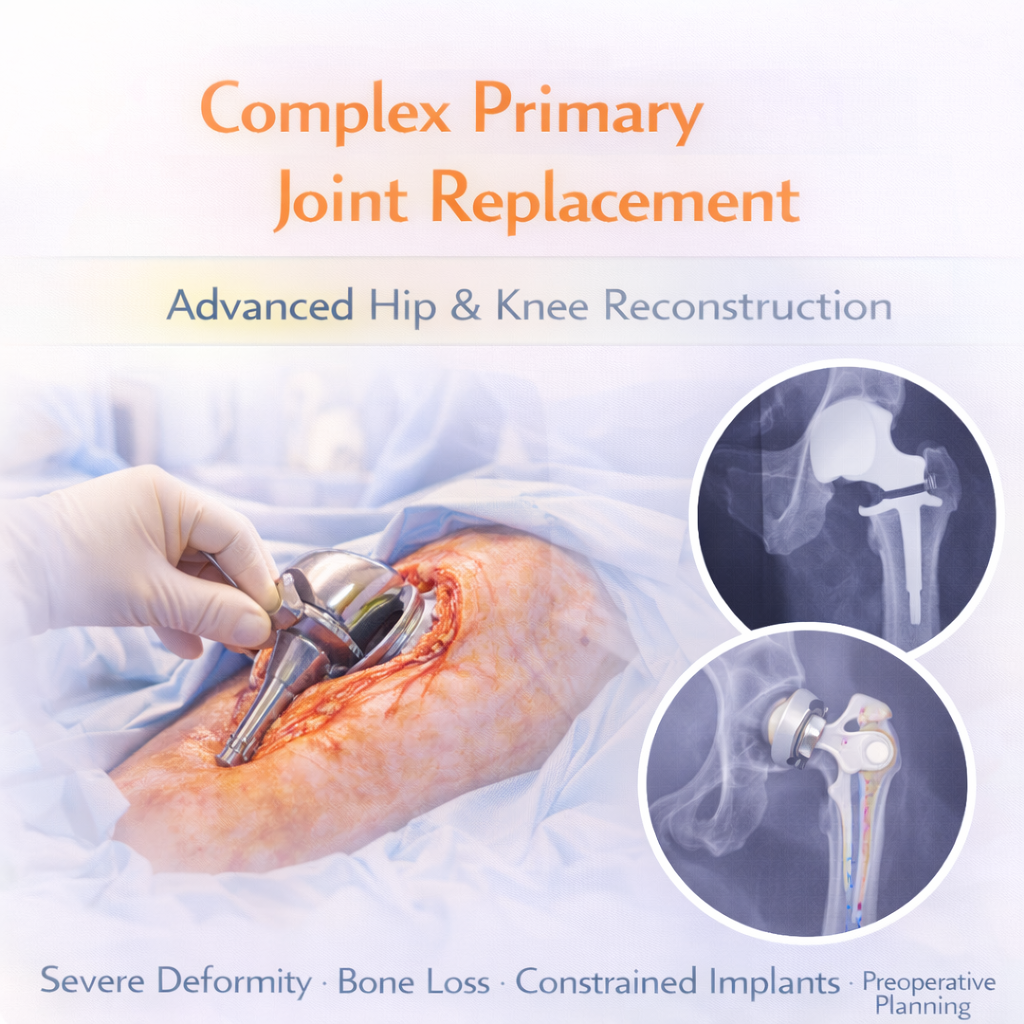
Complex Primary Joint Replacement refers to advanced joint replacement surgery performed in patients with severe deformity, bone loss, stiffness, previous trauma, or challenging anatomy — even though it is their first joint replacement.
Unlike routine joint replacement, these cases demand higher surgical expertise, advanced implants, and precise planning to achieve optimal alignment and long-term implant survival.
What Makes a Joint Replacement “Complex”?
A primary joint replacement becomes complex due to:
Severe deformity (varus/valgus knee, hip dysplasia)
Post-traumatic arthritis
Previous fracture around joint
Bone loss
Stiff or ankylosed joint
Long-standing neglected arthritis
Obesity or medical comorbidities
Previous hardware removal
These patients require individualized surgical strategy.
Common Complex Primary Procedures
1️⃣ Complex Total Knee Replacement (TKR)
Severe deformity correction
Ligament balancing
Use of constrained implants
2️⃣ Complex Total Hip Replacement (THR)
Dysplastic hip correction
Bone grafting
Specialized acetabular components
3️⃣ Conversion Arthroplasty
Joint replacement after failed previous fracture fixation.
Advanced Techniques Used
Preoperative 3D planning
Computer navigation / robotic assistance
Modular implants
Bone grafting & augments
Long stems
Constrained components
Precision reduces complication risk.
Benefits of Expert Complex Joint Replacement
✅ Correction of severe deformity
✅ Restoration of limb alignment
✅ Pain relief
✅ Improved mobility
✅ Long-term implant stability
✅ Better functional outcome
Recovery & Rehabilitation
Early mobilization
Physiotherapy from day one
Close monitoring for complications
Gradual strengthening
Recovery may take slightly longer than routine joint replacement depending on complexity.