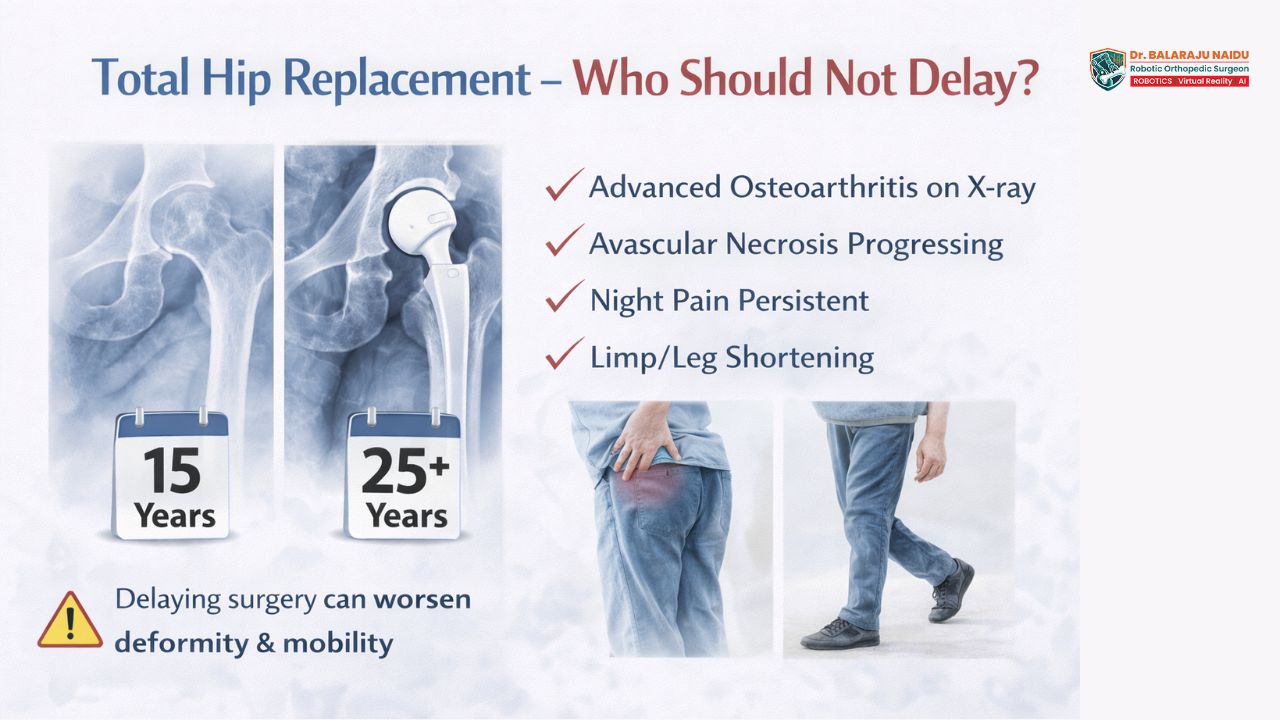
Total Hip Replacement – Who Should Not Delay Surgery? – By Dr. Balaraju Naidu, Robotic Orthopedic Surgeon, ONUS Robotic Hospitals
Hip pain can significantly affect mobility, independence, and quality of life. While many patients try medications, physiotherapy, or lifestyle modifications for years, there comes a stage when these measures no longer provide relief.
At that point, Total hip replacement (THR) becomes the most effective solution for restoring movement and eliminating chronic pain.
However, many patients delay surgery out of fear, misinformation, or the belief that they should wait until they are older. In advanced hip disease, delaying surgery can actually worsen outcomes.
What Is Total Hip Replacement?
Total hip replacement is a surgical procedure in which the damaged hip joint is replaced with an artificial implant.
The procedure involves replacing:
The damaged femoral head (ball)
The worn-out acetabulum (socket)
Modern hip implants are designed to provide:
Smooth joint movement
Long-term durability
Pain relief
Improved mobility
With current surgical techniques and implant designs, THR is considered one of the most successful orthopedic surgeries worldwide.
Conditions That Often Require Hip Replacement
Hip replacement is commonly performed for conditions such as:
Advanced osteoarthritis
Avascular necrosis
Rheumatoid arthritis
Hip fractures in elderly patients
Post-traumatic arthritis
Severe hip deformities
Among these, osteoarthritis and avascular necrosis are the most frequent causes.
Signs That You Should Not Delay Hip Replacement
Certain symptoms indicate that conservative treatment may no longer be effective.
1️⃣ Severe Hip Pain Affecting Daily Activities
When pain interferes with routine tasks such as:
Walking
Climbing stairs
Sitting or standing
It may indicate advanced joint damage.
2️⃣ Persistent Night Pain
Hip pain that disturbs sleep often suggests severe inflammation and cartilage loss.
Night pain is one of the most common reasons patients eventually seek surgery.
3️⃣ Limited Walking Distance
If you can walk only short distances due to pain or stiffness, the joint function may be significantly compromised.
Mobility restriction can lead to a sedentary lifestyle and further health complications.
4️⃣ Advanced Osteoarthritis on X-ray
Radiological signs such as:
Joint space narrowing
Bone-on-bone contact
Osteophyte formation
indicate advanced degeneration.
At this stage, conservative treatment rarely provides lasting relief.
5️⃣ Progressive Limb Deformity or Shortening
As hip arthritis progresses, patients may develop:
Limping gait
Limb length discrepancy
Joint stiffness
These structural changes can make surgery more complex if delayed too long.
Why Delaying Surgery Can Be Harmful
Many patients continue to tolerate severe pain for years. Unfortunately, prolonged delay can lead to complications.
Muscle Wasting
Chronic inactivity weakens surrounding muscles, making rehabilitation more difficult after surgery.
Increased Joint Deformity
Progressive cartilage loss and bone remodeling can cause deformities that complicate surgical correction.
Limb Shortening
Hip joint collapse may lead to limb length discrepancy.
Correcting this during surgery becomes more technically demanding.
Reduced Quality of Life
Persistent pain and limited mobility affect sleep, independence, and mental well-being.
Early surgical intervention in advanced cases can restore normal function more effectively.
Who Can Safely Wait Before Surgery?
Not every patient with hip pain requires immediate surgery.
Patients may continue conservative treatment if:
Symptoms are mild
Joint space is preserved on imaging
Mobility remains relatively normal
Pain responds to medications or physiotherapy
In such cases, lifestyle modifications and regular follow-up are appropriate.
Benefits of Timely Hip Replacement
When performed at the right time, total hip replacement provides:
Significant pain relief
Improved walking ability
Better posture and balance
Enhanced quality of life
Long-term joint stability
Many patients return to normal daily activities within months after surgery.
Final Thought
Hip replacement is not about age — it is about pain, mobility, and function.
When advanced joint damage is present, delaying surgery can worsen deformity and reduce surgical outcomes.
Early intervention in appropriate cases leads to faster recovery, better mobility, and improved long-term results.
Consult an experienced orthopedic surgeon to evaluate the severity of your hip condition and determine the best timing for surgery.
For Appointments:
Dr. Balaraju Naidu, Robotic Orthopedic Surgeon
ONUS Robotic Hospitals – Hyderabad
👉 link: contact-us or book-appointment