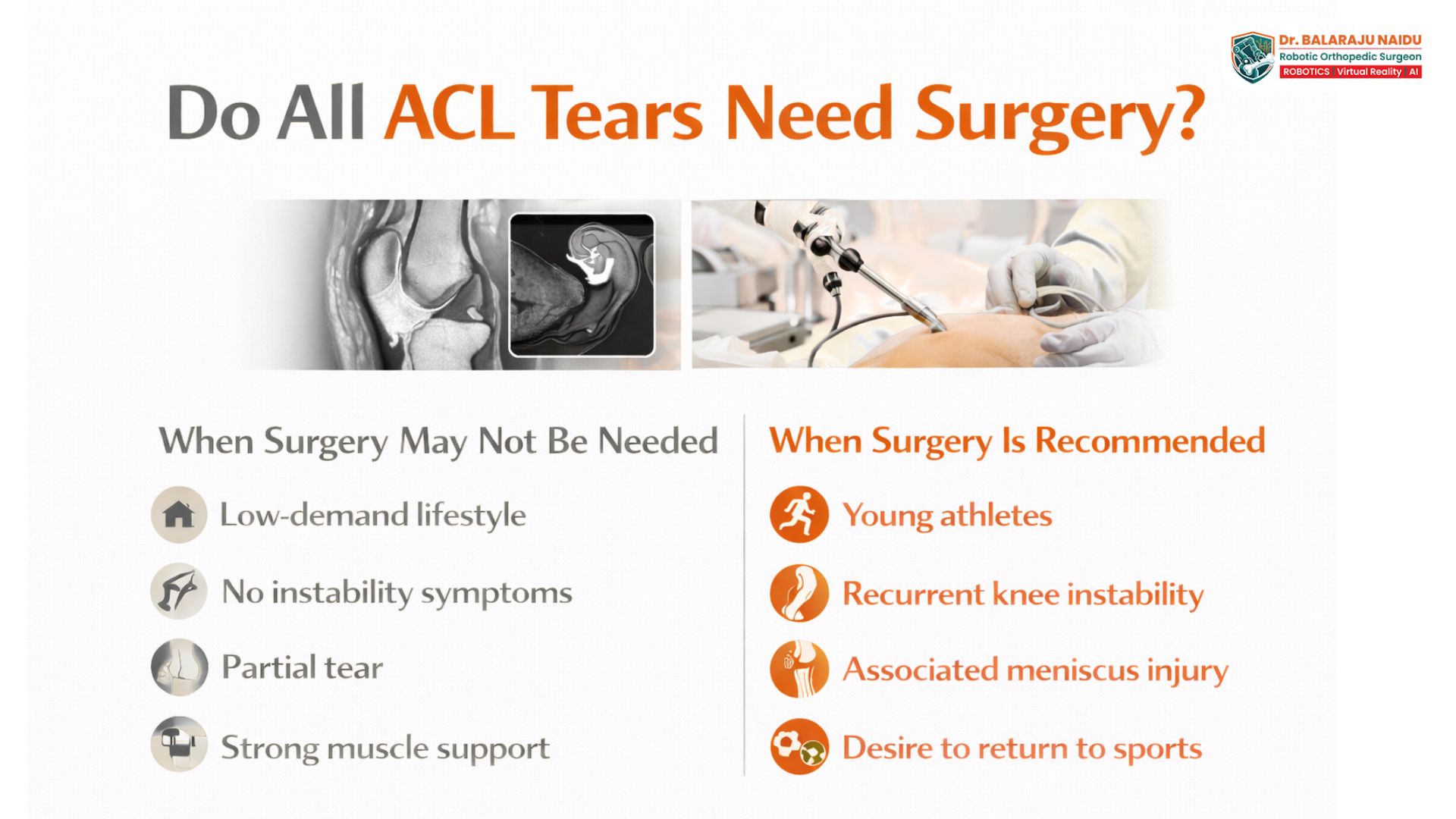
Do All ACL Tears Need Surgery? Understanding Treatment Options for ACL Injuries – By Dr. Balaraju Naidu, Robotic Orthopedic Surgeon, ONUS Robotic Hospitals
Injuries to the Anterior Cruciate Ligament are among the most common sports-related knee injuries, especially in young and active individuals. ACL tears often occur during activities that involve sudden changes in direction, jumping, or pivoting movements.
Many patients assume that an ACL tear automatically means surgery. However, this is not always the case. The decision to perform surgery depends on several factors including the patient’s lifestyle, activity level, degree of instability, and associated knee injuries.
Understanding when surgery is necessary—and when non-surgical treatment may be sufficient—can help patients make informed decisions about their knee health.
What Is the ACL and Why Is It Important?
The anterior cruciate ligament (ACL) is one of the major ligaments that stabilizes the knee joint. It connects the thigh bone (femur) to the shin bone (tibia) and prevents excessive forward movement of the tibia.
The ACL plays a critical role in:
Maintaining knee stability
Supporting pivoting movements
Allowing safe participation in sports and physical activity
When the ACL is torn, the knee may become unstable, especially during activities that involve sudden direction changes.
Do All ACL Tears Require Surgery?
No. Treatment for an ACL tear is individualized.
Some patients can manage well with conservative treatment, while others require surgical reconstruction to restore knee stability.
The decision depends largely on how the patient uses their knee in daily life.
When ACL Surgery May Not Be Necessary
In certain cases, non-surgical management may be sufficient.
Conservative treatment may be considered when:
Low-Demand Lifestyle
Individuals who do not participate in high-impact sports or physically demanding activities may be able to function well without ACL reconstruction.
No Knee Instability
If the knee remains stable during daily activities and the patient does not experience episodes of the knee “giving way,” surgery may not be required.
Partial ACL Tear
Some ACL injuries involve only partial damage to the ligament. With proper physiotherapy and strengthening exercises, patients may regain adequate knee stability.
Strong Muscle Support
A well-structured physiotherapy program focusing on quadriceps and hamstring strengthening can improve knee stability and reduce symptoms.
In such cases, rehabilitation plays a key role in recovery.
When ACL Surgery Is Recommended
Certain patients benefit significantly from **ACL reconstruction surgery.
Surgery is usually recommended when:
Young Athletes
Athletes involved in sports such as football, basketball, cricket, or badminton often require ACL reconstruction to return safely to sports.
Recurrent Knee Instability
If the knee repeatedly “gives way,” the risk of additional damage increases.
Persistent instability usually indicates the need for surgical reconstruction.
Associated Meniscus Injury
ACL tears are often accompanied by meniscus damage, which can worsen if instability persists.
In such cases, surgery may be necessary to protect the knee joint.
Desire to Return to Sports
Patients who wish to resume competitive or high-impact sports typically require ACL reconstruction to restore full knee stability.
Why Knee Stability Matters
Ignoring ACL instability can lead to long-term problems.
Repeated episodes of knee instability may result in:
Meniscus damage
Cartilage injury
Early onset osteoarthritis
Chronic knee pain and swelling
Addressing instability early helps preserve long-term knee health.
Role of MRI in ACL Injuries
An MRI scan of the knee is the most reliable imaging test for diagnosing ACL tears.
MRI helps doctors determine:
Whether the tear is partial or complete
Presence of meniscus injuries
Cartilage damage
Associated ligament injuries
However, MRI findings must always be correlated with clinical examination and patient symptoms.
Importance of Physiotherapy
Whether treated surgically or non-surgically, physiotherapy plays a critical role in ACL recovery.
Rehabilitation programs help:
Strengthen knee muscles
Restore joint stability
Improve range of motion
Reduce the risk of reinjury
For many patients, proper rehabilitation determines the final outcome.
Final Thought
Not every ACL tear requires immediate surgery.
Treatment decisions depend on:
Activity level
Knee stability
Associated injuries
Long-term goals
MRI shows the damage, but lifestyle and functional demands determine the treatment plan.
Consulting an experienced orthopedic specialist ensures that patients receive the most appropriate treatment for their specific condition.
For Appointments:
Dr. Balaraju Naidu, Robotic Orthopedic Surgeon
ONUS Robotic Hospitals – Hyderabad