How 3D Planning Improves Joint Replacement Accuracy – By Dr. Balaraju Naidu, Robotic Orthopedic Surgeon, ONUS Robotic Hospitals
Joint replacement surgery has witnessed remarkable advancements over the last two decades. Modern technologies are now helping surgeons perform procedures with far greater precision than ever before. One of the most important innovations transforming orthopedic surgery is 3D surgical planning.
Traditionally, joint replacement procedures relied on intraoperative measurements, mechanical alignment guides, and the surgeon’s experience to determine implant positioning. Today, advanced imaging and digital modeling allow surgeons to plan the entire surgery before entering the operating room.
This technology is improving surgical accuracy, reducing variability, and enhancing patient outcomes in procedures such as **Total Knee Replacement and Total Hip Replacement.
What is 3D Planning in Joint Replacement?
3D planning refers to the use of advanced imaging technology to create a detailed digital model of a patient’s joint prior to surgery.
Using CT scans and specialized planning software, surgeons can visualize the patient’s anatomy in three dimensions and simulate the procedure virtually.
This process typically includes:
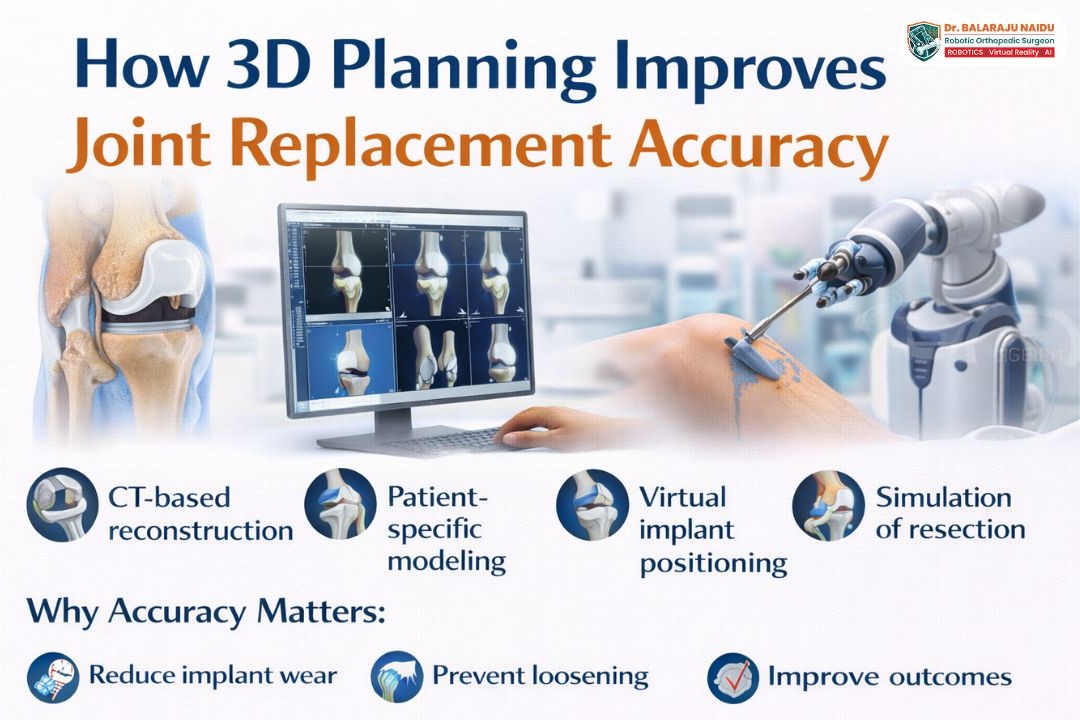
CT-based reconstruction of the joint
Patient-specific digital modeling
Virtual implant positioning
Simulation of bone cuts and resections
Assessment of joint alignment and biomechanics
By performing this planning step beforehand, surgeons can optimize surgical decisions long before the actual procedure begins.
How 3D Planning Works
The process usually begins with a CT scan of the affected joint.
The scan data is then converted into a highly accurate 3D model of the patient’s bone structure. Specialized software allows the surgeon to examine this model from multiple angles and plan the procedure in detail.
During this planning phase, the surgeon can:
Determine the ideal implant size
Decide optimal implant positioning
Plan bone resection angles
Assess ligament balance
Simulate range of motion after surgery
This digital simulation helps reduce uncertainty during the actual surgery.
Key Advantages of 3D Surgical Planning
Improved Implant Alignment
Proper implant alignment is critical for the long-term success of joint replacement. Even small alignment errors can affect implant performance.
3D planning helps surgeons place implants with greater accuracy.
Personalized Surgical Approach
Every patient’s anatomy is different. 3D planning allows surgeons to tailor the procedure according to the patient’s specific bone structure rather than relying on generalized alignment methods.
Better Ligament Balance
Joint stability depends on proper balancing of surrounding ligaments. Digital planning allows surgeons to anticipate and adjust for ligament tension before surgery.
Reduced Intraoperative Guesswork
Traditional techniques often require adjustments during surgery. With 3D planning, many decisions are already finalized beforehand, making the procedure smoother and more predictable.
Enhanced Reproducibility
3D planning creates a standardized surgical roadmap, which helps improve consistency and reproducibility of results.
Why Surgical Accuracy Matters
Precision is one of the most important factors influencing the success of joint replacement surgery.
Even small alignment deviations can lead to complications such as:
Increased implant wear
Implant loosening
Knee stiffness
Reduced joint function
Shortened implant lifespan
Accurate implant positioning improves biomechanics and helps ensure long-term implant durability.
Integration with Robotic-Assisted Surgery
3D planning becomes even more powerful when combined with robotic-assisted surgical systems.
Robotic platforms can use the preoperative digital plan to guide bone cuts with extreme precision. This integration ensures that the surgical plan is executed exactly as designed.
Such technologies are helping establish new standards in modern orthopedic surgery.
The Future of Joint Replacement
As orthopedic technology continues to evolve, 3D planning will play an increasingly important role in surgical decision-making.
Future developments may include:
AI-assisted surgical planning
Fully personalized implant design
Real-time intraoperative imaging
Enhanced robotic precision
The ultimate goal is not simply replacing damaged joints but restoring natural biomechanics and improving long-term patient mobility.
Final Thought
3D planning represents a major step forward in joint replacement surgery.
By combining advanced imaging, digital simulation, and surgical expertise, doctors can perform procedures with greater precision, predictability, and patient-specific customization.
Modern joint replacement is no longer just about replacing worn-out joints — it is about restoring function, stability, and quality of life.
For Appointments:
Dr. Balaraju Naidu, Robotic Orthopedic Surgeon
ONUS Robotic Hospitals – Hyderabad