Dr Balaraju Naidu

For Appointments Call 73967 77240 / 1800 103 1956

Daily 8AM to 9AM Uppal / Daily 9AM to 9PM Champapet / Daily 3PM to 4PM Tukkuguda

For Appointments Call 73967 77240 / 1800 103 1956

Daily 8AM to 9AM Uppal / Daily 9AM to 9PM Champapet / Daily 3PM to 4PM Tukkuguda

Daily 8AM to 9AM Uppal / Daily 9AM to 9PM Champapet / Daily 3PM to 4PM Tukkuguda

Best Orthopaedic surgeons in Hyderabad

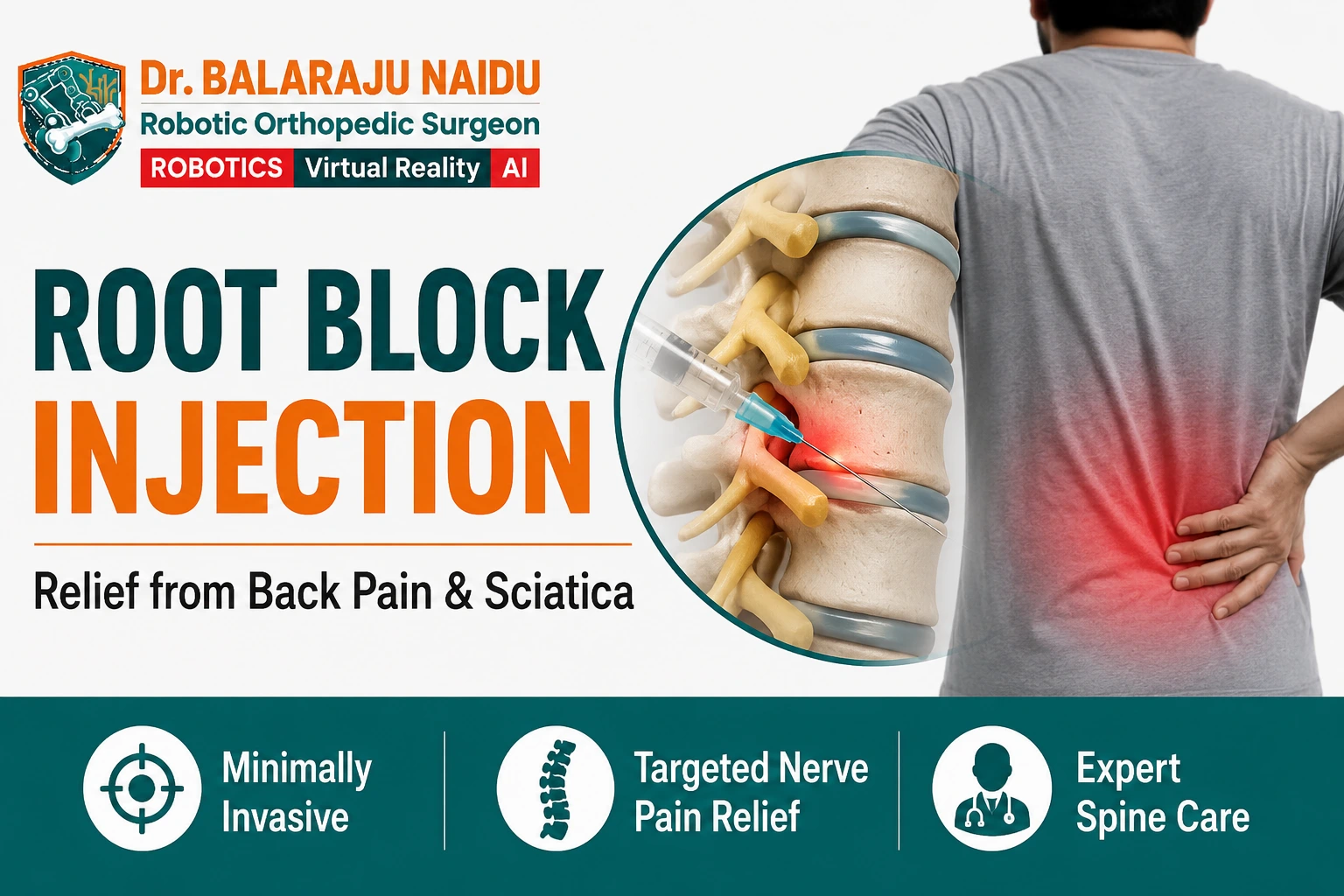
Root Block Injection for Back Pain Relief- By Dr. Balaraju Naidu, Robotic Orthopedic Surgeon, ONUS Robotic Hospitals

A Minimally Invasive Treatment for Sciatica and Nerve Compression

Back pain is one of the leading causes of disability worldwide. While many cases improve with rest, medications, and physiotherapy, some people continue to experience severe pain that radiates from the lower back into the buttock, thigh, calf, or foot. This type of pain is often caused by irritation or compression of a spinal nerve root.

A Root Block Injection, also known as a Selective Nerve Root Block (SNRB), is a minimally invasive procedure that delivers medication directly around the affected nerve to reduce inflammation, relieve pain, and improve mobility.

At ONUS Robotic Hospitals, Root Block Injections are performed under image guidance by experienced specialists to ensure precision, safety, and effective pain relief.


What Is a Root Block Injection?

A Root Block Injection is a targeted pain management procedure in which a combination of a local anesthetic and an anti-inflammatory corticosteroid medication is injected near the irritated spinal nerve root.

The injection helps:

  • Reduce inflammation around the nerve
  • Relieve nerve pain
  • Decrease swelling
  • Improve walking ability
  • Allow patients to participate in physiotherapy
  • Delay or avoid surgery in selected patients

Because the medication is delivered directly to the source of pain, patients often experience better relief compared to oral medications alone.


Who May Benefit from a Root Block Injection?

Your doctor may recommend this procedure if you have:

  • Sciatica
  • Slipped or herniated lumbar disc
  • Lumbar disc prolapse
  • Nerve root compression
  • Lumbar spinal stenosis
  • Chronic lower back pain radiating to the leg
  • Degenerative spine disease
  • Persistent pain despite medications and physiotherapy

It is especially useful for patients whose leg pain is more severe than their back pain.

Common Symptoms of Nerve Root Compression

Patients with nerve root irritation may experience:

  • Sharp lower back pain
  • Pain radiating to the buttock or leg
  • Burning sensation in the leg
  • Tingling or numbness
  • Weakness in the leg or foot
  • Pain while sitting or walking
  • Difficulty standing for long periods
  • Pain that worsens while coughing or sneezing

If these symptoms continue despite conservative treatment, further evaluation is recommended.


How Is the Procedure Performed?

Root Block Injection is usually performed as a day-care procedure.

Step 1 – Clinical Assessment

The doctor evaluates your symptoms, physical examination findings, and MRI or imaging reports to identify the affected nerve.

Step 2 – Image Guidance

The procedure is performed using fluoroscopy (X-ray guidance) or ultrasound guidance to accurately locate the nerve root.

Step 3 – Injection

After cleaning the skin and administering local anesthesia, a fine needle is carefully positioned near the affected nerve root.

A combination of:

  • Local anesthetic
  • Anti-inflammatory steroid medication

is then injected.

The procedure usually takes 15–30 minutes.


Benefits of Root Block Injection

Root Block Injection offers several advantages, including:

  • Rapid pain relief
  • Reduced nerve inflammation
  • Improved mobility
  • Better quality of life
  • Faster return to daily activities
  • Reduced dependence on pain medications
  • Improved participation in physiotherapy
  • May delay or prevent surgery in selected patients

Results vary depending on the underlying spinal condition.


Conditions Commonly Treated

Root Block Injection may be recommended for:

  • Herniated (slipped) disc
  • Sciatica
  • Lumbar radiculopathy
  • Foraminal stenosis
  • Degenerative disc disease
  • Post-surgical nerve pain
  • Chronic nerve inflammation

Recovery After the Procedure

Most patients return home on the same day.

Following the injection:

  • Rest for the remainder of the day
  • Resume light activities the following day unless advised otherwise
  • Avoid strenuous exercise for a short period
  • Continue prescribed physiotherapy if recommended
  • Follow up with your spine specialist as scheduled

Some patients experience immediate relief due to the local anesthetic, while the steroid medication may take a few days to achieve its full effect.


Is Root Block Injection Safe?

When performed by trained specialists under image guidance, Root Block Injection is generally considered a safe procedure.

Possible temporary side effects include:

  • Mild soreness at the injection site
  • Temporary numbness
  • Temporary weakness
  • Facial flushing
  • Slight increase in blood sugar (especially in diabetic patients)

Serious complications are uncommon but, like any medical procedure, they can occur. Your doctor will discuss the risks and benefits before treatment.


When Should You Consult a Spine Specialist?

Seek medical attention if you experience:

  • Persistent back pain lasting several weeks
  • Pain radiating down the leg
  • Numbness or weakness
  • Difficulty walking
  • Loss of bladder or bowel control (medical emergency)
  • Severe pain that does not improve with medication

Early diagnosis helps prevent long-term nerve damage and improves treatment outcomes.


Why Choose ONUS Robotic Hospitals?

At ONUS Robotic Hospitals, patients receive comprehensive spine care using advanced diagnostic and minimally invasive treatment techniques.

Our team provides:

  • Expert spine specialist consultation
  • Accurate diagnosis
  • Image-guided Root Block Injection
  • Personalized pain management
  • Physiotherapy and rehabilitation support
  • Advanced surgical care when required

Our goal is to reduce pain, restore movement, and improve your quality of life with evidence-based treatment.


Frequently Asked Questions (FAQs)

Is Root Block Injection painful?

The procedure is performed under local anesthesia, and most patients experience only mild discomfort.

How long does pain relief last?

Pain relief varies depending on the underlying condition. Some patients experience relief for weeks to months, while others may require additional treatment.

Can Root Block Injection avoid surgery?

In selected patients, the injection can significantly reduce symptoms and may delay or eliminate the need for surgery. However, this depends on the severity of the condition.

Can diabetic patients undergo Root Block Injection?

Yes, but blood sugar levels should be monitored because steroid medication may temporarily increase glucose levels.

How soon can I return to work?

Many patients can return to desk work within one or two days, depending on their symptoms and doctor’s advice.


Conclusion

Persistent back pain with leg pain should never be ignored. If nerve compression is causing your symptoms, a Root Block Injection may provide significant relief by reducing inflammation around the affected nerve and improving mobility without major surgery.

If you are experiencing sciatica, slipped disc symptoms, or chronic back pain that has not improved with medication or physiotherapy, consult the spine specialists at ONUS Robotic Hospitals for a comprehensive evaluation and personalized treatment plan.


For Appointments:

Dr. Balaraju Naidu, Robotic Orthopedic Surgeon

ONUS Robotic Hospitals – Hyderabad

👉 link: contact-us or book-appointment


Related Posts