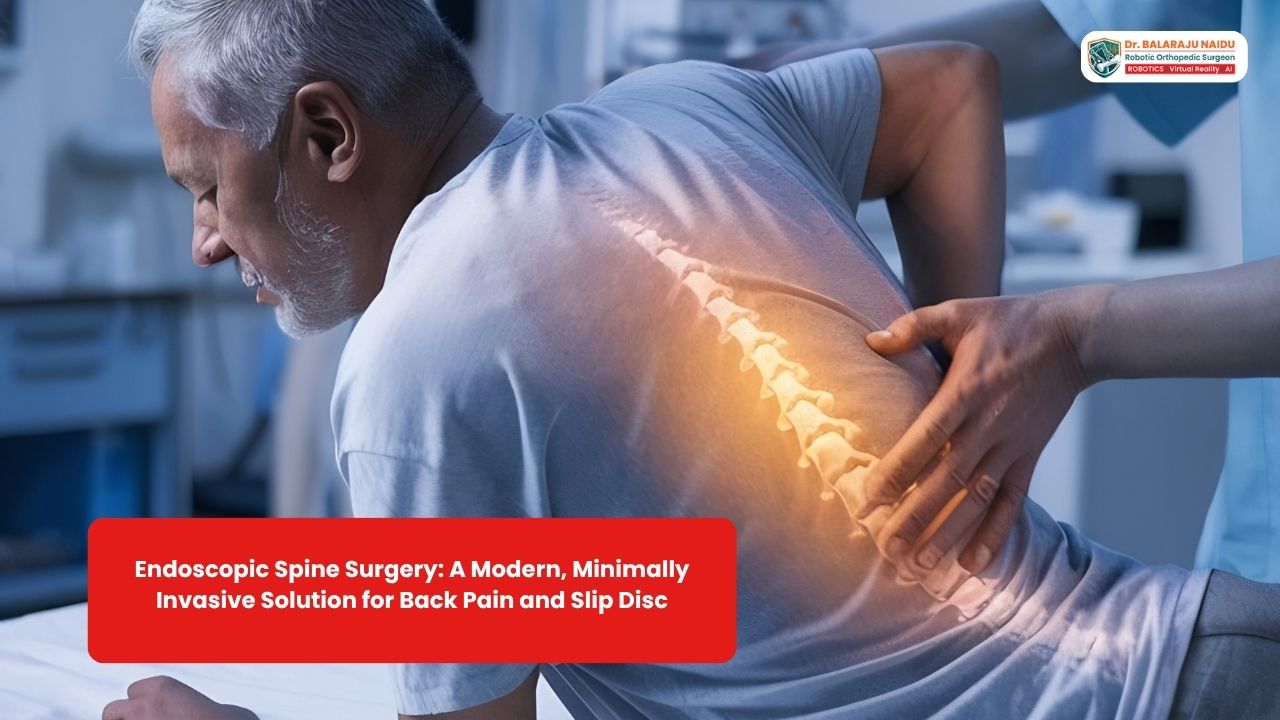
Endoscopic Spine Surgery: A Modern, Minimally Invasive Solution for Back Pain and Slip Disc- By Dr. Balaraju Naidu, Robotic Orthopedic Surgeon, ONUS Robotic Hospitals
Faster Recovery, Less Pain, and Precision Treatment for Spine Problems
Are you suffering from chronic back pain, slip disc, or nerve compression that is not improving with medications or physiotherapy?
Many patients believe traditional open surgery is the only option—but modern techniques have changed spine care.
Endoscopic Spine Surgery is an advanced, minimally invasive procedure that treats spine problems through a very small incision, allowing faster recovery and less pain.
What Is Endoscopic Spine Surgery?
Endoscopic spine surgery is a modern technique used to treat spine conditions using a small camera (endoscope) inserted through a tiny incision.
This approach allows surgeons to:
- Precisely identify the problem
- Remove damaged tissue
- Relieve nerve pressure
- Preserve surrounding muscles
Compared to traditional surgery, it causes minimal tissue damage.
How Is the Procedure Done?
The procedure is simple, precise, and minimally invasive.
Step-by-Step Procedure
- Small incision (less than 1 cm)
- A camera (endoscope) is inserted
- The affected nerve or disc is identified
- The problem area is treated
- The incision is closed
Most procedures are completed within:
30–90 minutes
Hospital stay is usually short.
Conditions Treated with Endoscopic Spine Surgery
This procedure is commonly used for:
1) Slip Disc (Herniated Disc)
One of the most common indications is Herniated Disc.
Symptoms include:
- Back pain
- Leg pain
- Numbness
- Weakness
2) Sciatica (Nerve Pain)
Another common condition is Sciatica.
Typical symptoms:
- Shooting leg pain
- Tingling
- Burning sensation
- Difficulty walking
3) Spinal Stenosis
This condition is called Spinal Stenosis.
It causes:
- Back pain
- Leg pain
- Walking difficulty
4) Nerve Compression
Endoscopic surgery is highly effective for relieving nerve pressure caused by:
- Disc problems
- Bone spurs
- Ligament thickening
Key Benefits of Endoscopic Spine Surgery
Modern minimally invasive spine surgery offers several advantages.
Major Benefits
- No large surgical cuts
- Less pain after surgery
- Minimal blood loss
- Reduced infection risk
- Short hospital stay
- Faster recovery
- Early return to work
These benefits make it one of the most preferred spine procedures today.
Endoscopic Surgery vs Traditional Spine Surgery
| Feature | Endoscopic Surgery | Traditional Surgery |
|---|---|---|
| Incision size | Very small | Large |
| Muscle damage | Minimal | Significant |
| Blood loss | Low | Higher |
| Recovery time | Faster | Slower |
| Hospital stay | Short | Longer |
Modern minimally invasive surgery significantly improves patient comfort.
Who Is the Right Candidate for Endoscopic Spine Surgery?
You may benefit from this procedure if:
- Back pain persists for more than 6 weeks
- Pain radiates to the leg
- Numbness or tingling occurs
- Physiotherapy does not help
- MRI shows nerve compression
Proper evaluation is essential before surgery.
Who May Not Need Surgery?
Many patients improve without surgery.
Non-surgical treatment may include:
- Physiotherapy
- Medications
- Lifestyle changes
- Injections
Surgery is recommended only when conservative treatment fails.
Recovery After Endoscopic Spine Surgery
Recovery is usually quick.
Typical Recovery Timeline
Day 1
- Walking begins
Week 1
- Return to light activities
Week 2–4
- Resume routine work
Month 1–2
- Full recovery
Most patients experience rapid improvement.
Is Endoscopic Spine Surgery Safe?
Yes.
When performed by trained specialists, the procedure is:
- Safe
- Precise
- Effective
- Minimally invasive
Complications are rare.
Warning Signs That Need Spine Evaluation
Consult a doctor if you experience:
- Persistent back pain
- Pain radiating to the leg
- Numbness or tingling
- Weakness in leg
- Difficulty walking
- Loss of bladder control
These symptoms require urgent evaluation.
Final Takeaway
Endoscopic spine surgery is:
✔ Minimally invasive
✔ Safe
✔ Effective
✔ Faster recovery
Modern technology allows spine problems to be treated with less pain and quicker return to normal life.
For Appointments:
Dr. Balaraju Naidu, Robotic Orthopedic Surgeon
ONUS Robotic Hospitals – Hyderabad