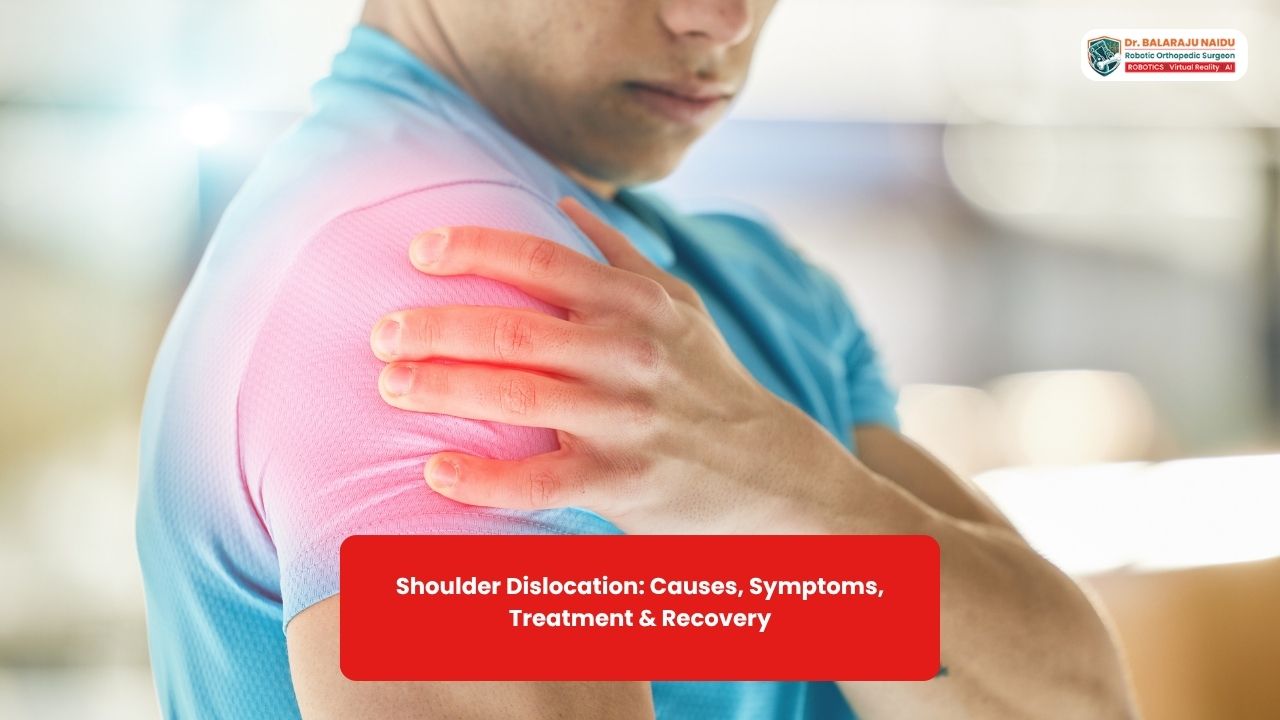
Shoulder Dislocation: Causes, Symptoms, Treatment & Recovery- By Dr. Balaraju Naidu, Robotic Orthopedic Surgeon, ONUS Robotic Hospitals
What to Do When Your Shoulder Slips Out of Place
Did your shoulder suddenly slip out of place after a fall, sports activity, or accident?
Severe pain, deformity, and inability to move the arm are classic signs of Shoulder Dislocation, a common but serious orthopedic emergency.
The shoulder joint is the most mobile joint in the body—and therefore the most likely to dislocate. Prompt treatment is critical to restore stability and prevent repeated injuries.
What Is a Shoulder Dislocation?
A shoulder dislocation occurs when the upper arm bone (humerus) comes out of the shoulder socket.
This can happen due to:
- Fall on an outstretched hand
- Sports injury
- Road traffic accident
- Sudden twisting movement
In some patients, repeated dislocations may occur due to ligament damage or instability.
Types of Shoulder Dislocation
1) Anterior Shoulder Dislocation (Most Common)
Occurs when the arm moves forward out of the socket.
Accounts for:
About 90–95% of cases
2) Posterior Shoulder Dislocation
Less common but can occur due to:
- Seizures
- Electric shock
- High-impact trauma
3) Recurrent Shoulder Dislocation
Some patients develop repeated dislocations due to:
- Weak ligaments
- Labral tear
- Shoulder instability
This condition is called:
Recurrent Shoulder Instability
Common Causes of Shoulder Dislocation
Falls
Most common cause, especially in elderly patients.
Sports Injuries
High-risk sports include:
- Cricket
- Football
- Kabaddi
- Gym workouts
- Wrestling
Accidents
Examples:
- Bike accidents
- Road traffic injuries
- Workplace injuries
Previous Shoulder Injury
Once dislocated, the shoulder becomes more prone to future dislocations.
Symptoms of Shoulder Dislocation
Typical symptoms include:
- Severe shoulder pain
- Visible deformity
- Inability to move the arm
- Swelling and bruising
- Shoulder instability
- Numbness or tingling
These symptoms usually appear immediately after injury.
Warning Signs That Need Emergency Care
Seek urgent medical attention if:
- Shoulder looks deformed
- Arm cannot move
- Severe pain occurs after fall
- Numbness develops
- Shoulder dislocates repeatedly
This is a medical emergency.
What Happens If Shoulder Dislocation Is Ignored?
Ignoring treatment can lead to:
- Repeated dislocations
- Ligament damage
- Chronic shoulder instability
- Cartilage injury
- Early arthritis
Early management prevents long-term joint damage.
How Is Shoulder Dislocation Diagnosed?
Doctors use:
Clinical Examination
Assessment of:
- Shoulder position
- Movement
- Pain
- Nerve function
Imaging Tests
Common tests include:
- X-ray
- MRI scan
- CT scan
MRI is especially useful to detect ligament or labral injury.
Treatment Options for Shoulder Dislocation
Treatment depends on severity and recurrence.
Step 1: Immediate Reduction (Emergency Treatment)
The first step is:
Putting the joint back into place
This procedure is called:
Reduction
Benefits:
- Relieves pain immediately
- Restores joint alignment
- Prevents complications
This must be performed by a trained doctor.
Step 2: Immobilization
After reduction, the shoulder is supported using:
- Arm sling
- Shoulder immobilizer
Typical duration:
2 to 4 weeks
Step 3: Physiotherapy
Physiotherapy is essential to:
- Strengthen shoulder muscles
- Restore movement
- Prevent recurrence
- Improve stability
This is a critical part of recovery.
Step 4: Arthroscopic Surgery (For Recurrent Dislocation)
Surgery may be required if:
- Shoulder dislocates repeatedly
- Ligaments are torn
- Joint is unstable
Modern treatment uses:
Shoulder Arthroscopy
Benefits:
- Small incision
- Less pain
- Faster recovery
- Better stability
Recovery Timeline After Shoulder Dislocation
Typical recovery depends on injury severity.
Mild cases
- 4 to 6 weeks
Moderate cases
- 6 to 12 weeks
Surgical cases
- 3 to 6 months
Early rehabilitation improves recovery speed.
Who Is at High Risk for Shoulder Dislocation?
Higher risk groups include:
- Athletes
- Young adults
- Elderly patients
- People with weak ligaments
- Previous shoulder injury
Prevention strategies are important for these groups.
Prevention Tips for Shoulder Dislocation
You can reduce risk by:
- Strengthening shoulder muscles
- Warming up before sports
- Using protective gear
- Avoiding risky movements
- Following physiotherapy advice
Prevention reduces recurrence.
When Should You See an Orthopedic Specialist?
Consult a doctor immediately if:
- Shoulder slips out of place
- Severe shoulder pain occurs after fall
- Arm cannot be moved
- Shoulder feels unstable
- Dislocation happens repeatedly
Early treatment prevents complications.
Final Takeaway
Shoulder dislocation is:
✔ Common
✔ Painful
✔ Treatable
✔ Preventable
The key message:
Early treatment restores stability and prevents repeated dislocations.
Ignoring the problem increases long-term damage risk.
For Appointments:
Dr. Balaraju Naidu, Robotic Orthopedic Surgeon
ONUS Robotic Hospitals – Hyderabad