

Robotic Partial Knee Replacement
Robotic Total Knee Replacement (TKR)
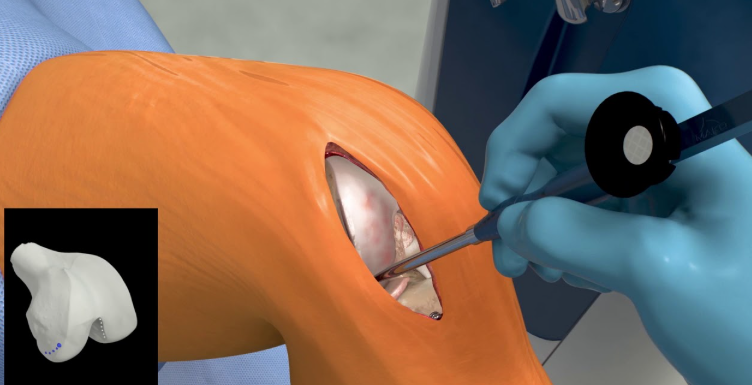
Robotic Partial Knee Replacement
Overview
Robotic Partial Knee Replacement, also known as Robotic Unicompartmental Knee Replacement (UKR), is a highly advanced, joint-preserving knee surgery designed for patients whose arthritis is limited to only one compartment of the knee—medial, lateral, or patellofemoral.
Unlike total knee replacement, this procedure replaces only the damaged portion of the knee, while preserving healthy bone, cartilage, ligaments, and natural knee movement. Robotic assistance allows extreme precision, making the surgery more predictable and durable.
Under the expertise of Dr. Balaraju Naidu, robotic partial knee replacement is performed with meticulous planning and execution, offering patients faster recovery and a more natural-feeling knee.
What Is Robotic Partial Knee Replacement?
The knee has three compartments:
Medial (inner side)
Lateral (outer side)
Patellofemoral (kneecap region)
When arthritis affects only one compartment, robotic partial knee replacement allows targeted resurfacing of the damaged area using robotic guidance.
Robotic technology enables:
3D mapping of the patient’s knee
Exact identification of the diseased compartment
Accurate implant size and placement
Protection of healthy ligaments (especially ACL & PCL)
The result is a knee that feels closer to normal than a total knee replacement.
Who Is an Ideal Candidate?
Indications
Robotic partial knee replacement is recommended for patients with:
Localized knee arthritis (single compartment)
Intact ligaments (especially ACL)
Stable knee without severe deformity
Persistent pain limited to one side of the knee
Failure of conservative treatments (medication, injections, physiotherapy)
Desire to maintain natural knee movement
It is particularly suitable for active individuals who want faster recovery and better knee function.
Advantages of Robotic Partial Knee Replacement
✅ Preserves healthy bone and ligaments
✅ Smaller incision and less tissue damage
✅ More natural knee movement
✅ Less post-operative pain
✅ Faster recovery and rehabilitation
✅ Shorter hospital stay
✅ Lower blood loss
✅ Easier future conversion to total knee replacement if needed
Robotic precision significantly reduces implant positioning errors, which is critical for long-term success in partial knee replacements.
Expertise of Dr. Balaraju Naidu
With advanced international training in robotic joint replacement and computer navigation, Dr. Balaraju Naidu brings global standards of care to partial knee replacement surgery.
His expertise includes:
Accurate patient selection (key for success)
Precise compartment assessment
Robotic planning for optimal implant positioning
Ligament balancing to preserve natural knee kinematics
Managing complex and borderline cases safely
This expertise ensures that only appropriate candidates undergo partial knee replacement, leading to superior outcomes.
Procedure: Step-by-Step
Preoperative Evaluation
Detailed clinical assessment and imaging to confirm single-compartment disease.Robotic Surgical Planning
A 3D knee model is created to plan bone cuts and implant placement with millimeter accuracy.Robotic-Assisted Surgery
The robot guides precise bone preparation while preserving surrounding tissues.Implant Placement & Verification
Real-time assessment of alignment, stability, and movement before final fixation.
Recovery & Rehabilitation
Walking usually begins on the same day or next day
Hospital stay is often 1–2 days
Faster return to daily activities compared to total knee replacement
Physiotherapy focuses on early mobility and strength
Many patients resume routine activities within 2–3 weeks
Why Choose Robotic Partial Knee Replacement?
Advanced robotic technology
Joint-preserving philosophy
Internationally trained robotic surgeon
Faster recovery with natural knee feel
Ideal option before considering total knee replacement