

Revision Knee Replacement Surgery
Revision Knee Replacement Surgery
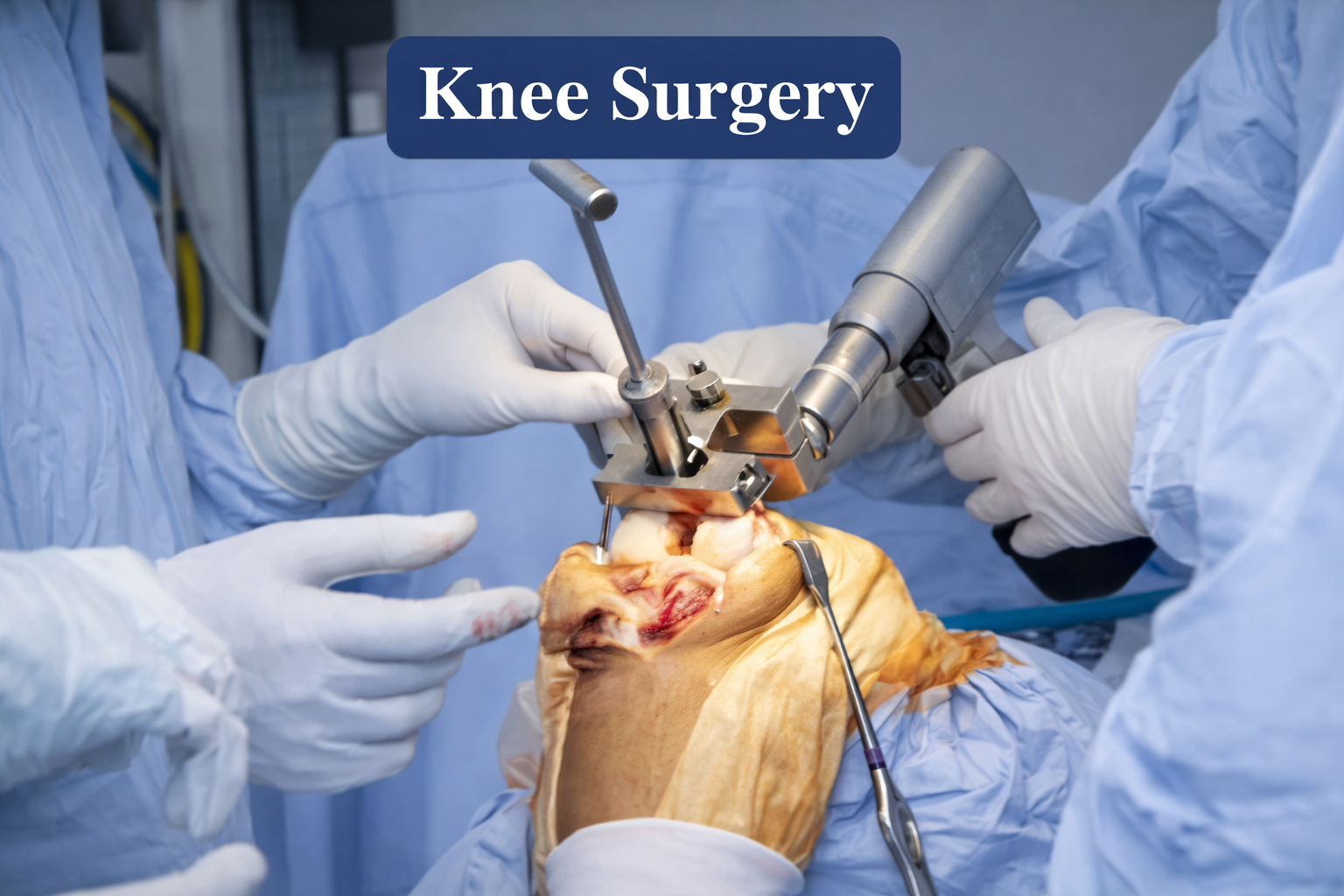
Overview
Revision Knee Replacement is a highly specialized redo surgery performed when a previously implanted knee replacement fails to provide pain relief, stability, or function. Unlike primary knee replacement, revision surgery is technically complex, requiring advanced planning, bone reconstruction, and precise implant selection.
Under the expertise of Dr. Balaraju Naidu, revision knee replacement focuses on identifying the exact cause of failure, restoring joint stability, managing bone loss, and rebuilding a durable, pain-free knee—often in situations where standard surgery is not sufficient.
What Is Revision Knee Replacement?
Revision knee replacement involves removing a failed or problematic knee implant and replacing it with a new, specially designed revision implant. These implants are more complex and may include stems, augments, cones, or custom components to compensate for bone loss and instability.
Revision surgery may be:
Partial revision – replacing one component
Complete revision – replacing the entire knee prosthesis
Staged revision – often required in infection cases
Each case is unique and requires individualized surgical strategy.
When Is Revision Knee Replacement Needed?
Indications
Revision knee replacement is recommended for:
Implant loosening (aseptic loosening)
Infection after knee replacement
Persistent or worsening knee pain
Implant wear or breakage
Knee instability or recurrent swelling
Stiffness or loss of motion
Peri-prosthetic fractures (fracture around implant)
Malalignment or incorrect implant positioning
Failure of previous revision surgery
Early evaluation is critical to prevent further bone damage.
Challenges in Revision Knee Replacement
Revision knee replacement is significantly more complex than primary surgery due to:
Bone loss around the implant
Scar tissue and soft-tissue damage
Infection control requirements
Ligament insufficiency
Poor bone quality
Distorted anatomy
Successful outcomes depend heavily on surgeon expertise and experience.
Benefits of Revision Knee Replacement
✅ Relief from chronic pain
✅ Improved stability and function
✅ Correction of deformity and malalignment
✅ Restoration of walking ability
✅ Elimination or control of infection
✅ Improved quality of life
✅ Prevention of further joint damage
When performed correctly, revision surgery can restore confidence and mobility even after failed prior surgeries.
Surgical Expertise of Dr. Balaraju Naidu
With advanced international training in complex joint reconstruction, robotic and navigation-assisted surgery, and peri-prosthetic fracture fixation, Dr. Balaraju Naidu specializes in challenging revision knee replacements.
Key expertise areas include:
Advanced bone loss management (cones, augments, stems)
Infection management (single-stage & two-stage revisions)
Ligament balancing and constraint selection
Managing failed implants and deformities
Computer navigation support for alignment accuracy
Complex reconstructions after multiple prior surgeries
This expertise is crucial for predictable outcomes in revision cases.
Procedure: Step-by-Step
Comprehensive Evaluation
Detailed clinical assessment, blood tests, imaging, and infection workup.Surgical Planning
Implant selection and reconstruction strategy based on bone loss and stability.Revision Surgery
Removal of failed implant, reconstruction of bone defects, and placement of revision prosthesis.Verification & Stability Check
Alignment, fixation, and joint stability are confirmed intraoperatively.
Recovery After Revision Knee Replacement
Hospital stay typically 3–5 days
Gradual mobilization with physiotherapy
Recovery may take longer than primary knee replacement
Pain relief improves progressively
Rehabilitation tailored to reconstruction complexity
Most patients regain functional walking and daily activity levels
Why Choose a Revision Knee Replacement Specialist?
Revision knee replacement should be performed by a dedicated revision arthroplasty specialist due to its complexity.
Choosing an expert ensures:
Accurate diagnosis of failure cause
Proper implant selection
Effective bone reconstruction
Lower risk of repeat failure
Better long-term outcomes