Dr Balaraju Naidu

For Appointments Call 73967 77240 / 1800 103 1956

Daily 8AM to 9AM Uppal / Daily 9AM to 9PM Champapet / Daily 3PM to 4PM Tukkuguda

For Appointments Call 73967 77240 / 1800 103 1956

Daily 8AM to 9AM Uppal / Daily 9AM to 9PM Champapet / Daily 3PM to 4PM Tukkuguda

Daily 8AM to 9AM Uppal / Daily 9AM to 9PM Champapet / Daily 3PM to 4PM Tukkuguda

Best Orthopaedic surgeons in Hyderabad

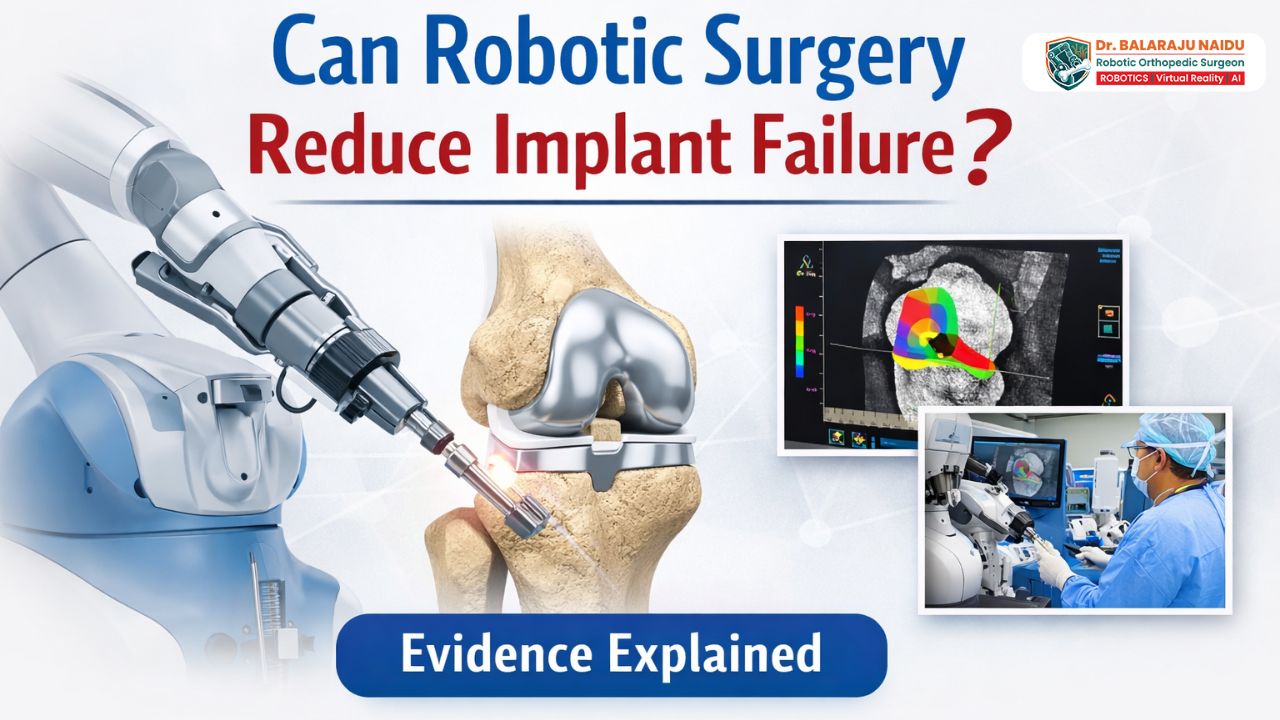
Can Robotic Surgery Reduce Implant Failure? Evidence Explained – By Dr. Balaraju Naidu, Robotic Orthopedic Surgeon, ONUS Robotic Hospitals

Joint replacement surgery has transformed millions of lives. However, implant longevity remains a major concern for both patients and surgeons. With the rise of robotic-assisted technology, an important question emerges:

Can robotic surgery truly reduce implant failure rates?

Let’s examine the science — not the hype.


Why Do Implants Fail?

Implant failure in knee and hip replacement is multifactorial. The most common causes include:

  • Malalignment

  • Implant loosening

  • Excessive polyethylene wear

  • Infection

  • Instability

  • Ligament imbalance

  • Poor patient-related factors (obesity, bone quality, compliance)

Among these, alignment, positioning, and soft tissue balance are surgeon-controlled variables. Even a 2–3° malalignment can significantly increase wear patterns and stress distribution, potentially accelerating failure.


The Alignment Problem in Conventional Surgery

In traditional joint replacement, surgeons rely on:

  • Mechanical jigs

  • Intramedullary or extramedullary guides

  • Visual assessment

  • Experience and tactile feedback

While experienced surgeons achieve excellent results, variability still exists. Studies show that conventional techniques can produce alignment “outliers,” which may impact implant longevity over time.


How Robotic Surgery Improves Precision

Robotic systems such as Mako Robotic-Arm Assisted Surgery System and ROSA Knee System introduce a data-driven workflow.

1. CT-Based 3D Mapping

  • Patient-specific 3D anatomical reconstruction

  • Detailed bone morphology analysis

  • Accurate implant sizing before surgery

2. Preoperative Digital Planning

  • Implant positioning simulation

  • Limb alignment correction planning

  • Personalized component orientation

3. Real-Time Intraoperative Feedback

  • Live tracking of bone cuts

  • Dynamic gap balancing

  • Quantitative ligament tension measurement

4. Haptic Boundary Protection

  • Prevents cutting outside predefined safe zones

  • Minimizes unintended bone resection

  • Enhances consistency


What Does the Research Say?

Current evidence (short- to mid-term data) demonstrates:

✅ Better Alignment Precision

Robotic systems significantly reduce alignment outliers compared to conventional techniques.

✅ Improved Soft Tissue Balance

Measured, reproducible ligament balancing leads to improved knee stability.

✅ Lower Variability

Reduced surgeon-dependent variability increases predictability across cases.

✅ Comparable or Slightly Improved Early Functional Outcomes

Some studies show:

  • Faster early recovery

  • Improved early pain scores

  • Higher patient satisfaction

⚠ Long-Term Survivorship Data

This is where honesty matters.

  • 10–15 year registry-level data is still evolving.

  • Early precision does not automatically guarantee decades-long survivorship.

  • Implant longevity depends on multiple variables beyond alignment alone.

However, alignment accuracy is strongly correlated with long-term biomechanical performance.


Does Precision Translate Into Reduced Failure?

The logic is biomechanically sound:

Better alignment
→ More even load distribution
→ Reduced edge loading
→ Reduced polyethylene wear
→ Lower loosening risk

But long-term proof requires time and registry validation.


Final Verdict

Robotic joint replacement:

  • Reduces technical error

  • Improves reproducibility

  • Enhances implant positioning accuracy

  • Reduces alignment outliers

Whether it significantly reduces long-term implant failure will depend on ongoing global registry data.

But one fact is clear:

Precision improves predictability.
Predictability improves confidence.
Confidence improves 
outcomes.


For Appointments:

Dr. Balaraju Naidu, Robotic Orthopedic Surgeon

ONUS Robotic Hospitals – Hyderabad

👉 link: contact-us or book-appointment

Related Posts