

Shoulder Instability Surgery
Shoulder Instability Surgery
Overview
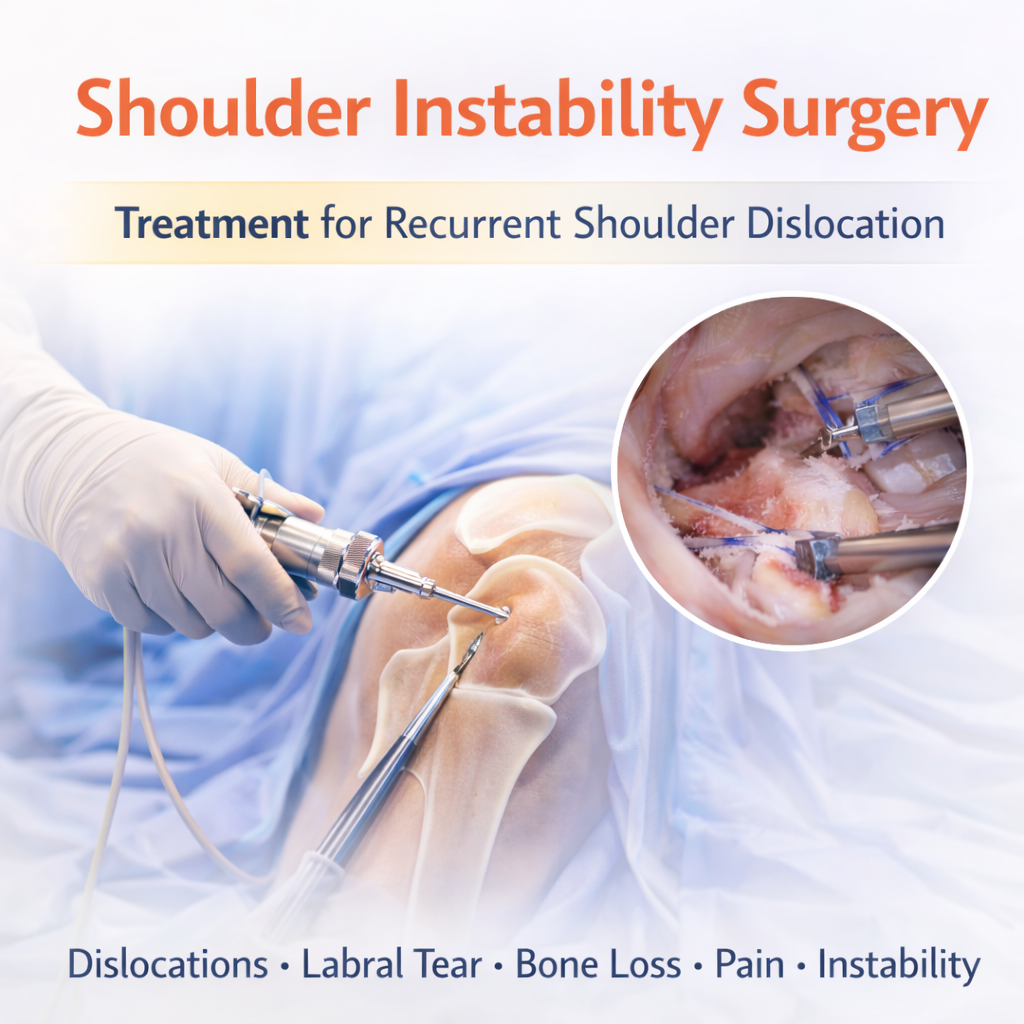
Shoulder Instability Surgery is performed to restore stability to a shoulder that repeatedly dislocates or feels like it may “slip out” of place. The shoulder joint has the greatest range of motion in the body, making it more prone to instability after trauma or ligament injury.
Recurrent dislocations can lead to cartilage damage, bone loss, and early arthritis if not treated appropriately.
What Is Shoulder Instability?
Shoulder instability occurs when the head of the humerus (ball) does not stay securely within the glenoid (socket).
It may result from:
Traumatic shoulder dislocation
Sports injuries (cricket, volleyball, gym activities)
Ligament laxity
Labral tears (Bankart lesion)
Bone defects after repeated dislocations
Types of Surgical Treatment
1. Arthroscopic Bankart Repair
Minimally invasive repair of torn labrum using anchors and sutures.
2. Latarjet Procedure
Bone block procedure for significant bone loss or recurrent failure.
3. Capsular Tightening (Capsular Shift)
Tightening loose ligaments to prevent recurrent instability.
The choice depends on the severity of instability and bone loss.
When Is Surgery Recommended?
Surgery is advised if you have:
Recurrent shoulder dislocations
Shoulder “giving way” sensation
MRI showing labral tear
Young and active lifestyle
Failure of physiotherapy
High-risk sports participation
Early surgery prevents further joint damage.
Benefits of Shoulder Instability Surgery
✅ Prevents recurrent dislocation
✅ Restores joint stability
✅ Protects cartilage from damage
✅ Enables return to sports
✅ Minimally invasive options available
✅ Long-term shoulder protection
Procedure – Step by Step
Clinical examination & MRI
Arthroscopic keyhole approach (most cases)
Repair of torn labrum using anchors
Ligament tightening
Stability testing
Duration: 60–120 minutes.
Recovery & Rehabilitation
Sling support for 3–4 weeks
Gradual physiotherapy
Strengthening after 6 weeks
Return to sports: 4–6 months
Proper rehabilitation is essential to prevent recurrence.