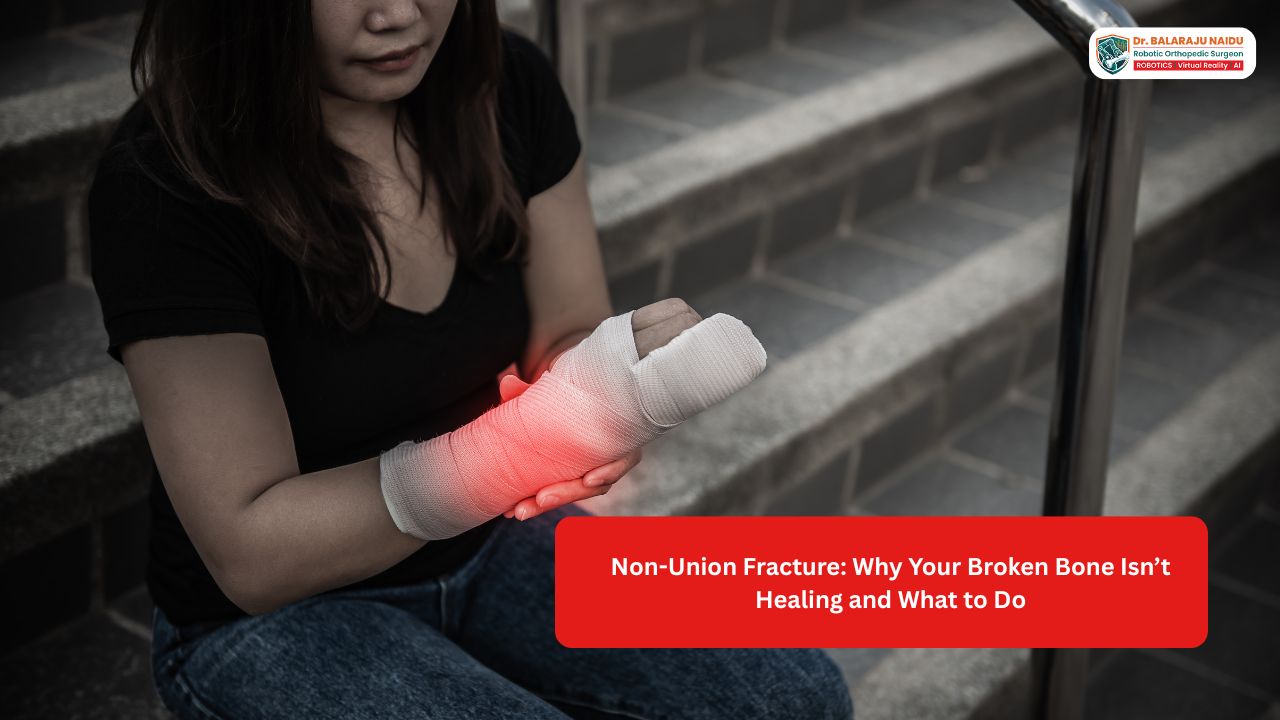
Non-Union Fracture: Why Your Broken Bone Isn’t Healing and What to Do- By Dr. Balaraju Naidu, Robotic Orthopedic Surgeon, ONUS Robotic Hospitals
Causes, Warning Signs, Diagnosis & Advanced Treatments to Restore Bone Healing
Is your fracture not healing even after weeks or months? Persistent pain, swelling, or movement at the fracture site may indicate a Non-Union Fracture.
At ONUS Robotic Hospitals, complex non-union cases are managed by specialists like Dr. Balaraju Naidu using advanced imaging, infection control, biologics, and modern fixation techniques.
Bottom line:
Early identification and the right strategy can restart healing and save function.
What Is a Non-Union Fracture?
A fracture typically heals in a predictable timeframe. When there is no visible progress toward healing over months, it is termed non-union.
How It Differs
- Normal union: Bone bridges and strengthens over time
- Delayed union: Healing is slow but progressing
- Non-union: Healing has stopped or failed
Why Do Some Fractures Fail to Heal?
Bone healing requires blood supply, stability, and biology. Disruption in any of these leads to non-union.
Common Causes
- Poor blood supply to bone
- Infection at fracture site
- Inadequate immobilization
- Gap between fracture ends
- Severe trauma or bone loss
- Smoking and alcohol
- Uncontrolled diabetes
- Malnutrition (low protein, calcium, Vitamin D)
Types of Non-Union
Understanding the type guides treatment.
1) Hypertrophic Non-Union (Biology Good, Stability Poor)
- Bone attempts to heal
- Callus forms but lacks stability
2) Atrophic Non-Union (Biology Poor)
- Minimal healing response
- Requires biological stimulation (grafts, cells)
Warning Signs You Should NOT Ignore
If you notice these symptoms, get evaluated:
- Persistent pain at fracture site
- Swelling lasting weeks/months
- Difficulty bearing weight
- Abnormal movement at fracture site
- Implant loosening or breakage
- No healing on repeat X-rays
Red flag: Pain + movement at fracture site after expected healing time.
How Is Non-Union Diagnosed?
Accurate diagnosis determines the plan.
Clinical Evaluation
- Pain assessment
- Stability testing
- Functional limitation
Imaging
- X-ray: First-line to assess healing
- CT Scan: Detailed bone bridging and gap analysis
- MRI (if needed): Soft tissue and infection
Lab Tests
- Infection markers (ESR, CRP)
- Blood sugar levels
- Nutritional profile
Treatment Goals
Treatment focuses on:
- Restoring stability
- Improving blood supply
- Eliminating infection
- Stimulating bone healing
Treatment Options for Non-Union
1) Infection Control (If Present)
- Debridement (removal of infected tissue)
- Targeted antibiotics
Infection must be cleared before reconstruction.
2) Stable Fixation (Mechanical Stability)
- Revision plating or nailing
- External fixation (selected cases)
- Use of advanced implants
Stability is critical for healing.
3) Bone Grafting (Biological Stimulation)
Bone Grafting
Types:
- Autograft (patient’s own bone)
- Allograft (donor bone)
- Synthetic substitutes
Enhances healing biology.
4) Biological Enhancers
- PRP (Platelet-Rich Plasma)
- Bone marrow aspirate
- Growth factors
Used in selected cases to boost healing.
5) Advanced Reconstruction Techniques
- Segmental reconstruction
- Limb lengthening (if bone loss)
- Combined fixation + grafting
Complex cases require specialized planning.
Recovery Timeline
Healing varies depending on:
- Type of non-union
- Bone involved
- Treatment method
- Patient health
Typical recovery:
- Initial stability: 4–6 weeks
- Early healing: 8–12 weeks
- Full recovery: 3–6 months (or more)
Adherence to physiotherapy is essential.
Role of Nutrition and Lifestyle
Bone healing is not just surgical—it’s metabolic.
Essential Factors
- High-protein diet
- Calcium and Vitamin D
- Blood sugar control
- Stop smoking
- Avoid alcohol
These significantly improve outcomes.
When Should You See an Orthopedic Specialist?
Consult urgently if:
- Fracture pain persists beyond expected healing time
- You cannot bear weight
- X-rays show no healing
- Implants feel unstable
- Swelling or infection signs appear
Early intervention prevents deformity and implant failure.
Final Takeaway
Non-union fracture is:
✔ Serious
✔ Treatable
✔ Preventable with early care
Remember:
A fracture that isn’t healing is not normal—don’t wait.
Early treatment can:
- Restore bone strength
- Prevent deformity
- Avoid implant failure
- Get you back to normal life
For Appointments:
Dr. Balaraju Naidu, Robotic Orthopedic Surgeon
ONUS Robotic Hospitals – Hyderabad