Dr Balaraju Naidu

For Appointments Call 73967 77240 / 1800 103 1956

Daily 8AM to 9AM Uppal / Daily 9AM to 9PM Champapet / Daily 3PM to 4PM Tukkuguda

For Appointments Call 73967 77240 / 1800 103 1956

Daily 8AM to 9AM Uppal / Daily 9AM to 9PM Champapet / Daily 3PM to 4PM Tukkuguda

Daily 8AM to 9AM Uppal / Daily 9AM to 9PM Champapet / Daily 3PM to 4PM Tukkuguda

Best Orthopaedic surgeons in Hyderabad

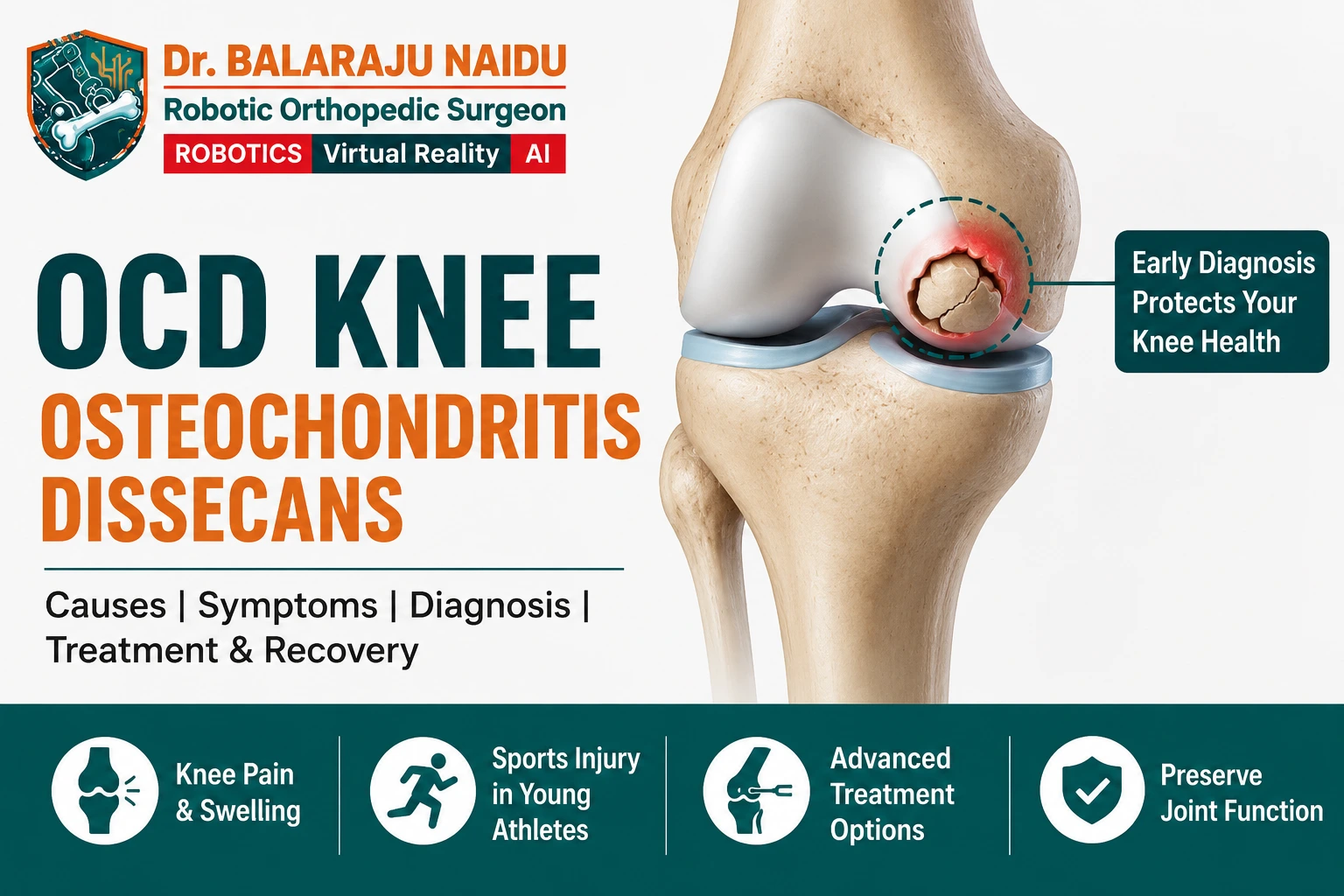
Osteochondritis Dissecans (OCD) of the Knee: Causes, Symptoms, Diagnosis & Treatment- By Dr. Balaraju Naidu, Robotic Orthopedic Surgeon, ONUS Robotic Hospitals

Introduction

Persistent knee pain in children, teenagers, or young adults should never be ignored. While many assume it is simply due to overuse or a sports injury, it may sometimes be caused by Osteochondritis Dissecans (OCD) of the Knee.

Osteochondritis Dissecans is a condition in which a small segment of bone beneath the cartilage loses its blood supply. As a result, the bone and the overlying cartilage may weaken, loosen, or even separate from the surrounding bone. If left untreated, it can lead to chronic pain, joint instability, and early arthritis.

Fortunately, early diagnosis and appropriate treatment can help preserve the knee joint and restore normal function.

In this article, Dr. Balaraju Naidu, Robotic Orthopedic Surgeon at ONUS Robotic Hospitals, explains everything you need to know about OCD of the knee, including its causes, symptoms, diagnosis, treatment options, and recovery.


What Is Osteochondritis Dissecans (OCD)?

Osteochondritis Dissecans (OCD) is a joint condition where a small piece of bone beneath the joint cartilage begins to lose its blood supply. Without adequate blood flow, the affected bone becomes weak, and the cartilage covering it may crack or detach.

If the bone and cartilage fragment becomes loose, it may float inside the knee joint, causing pain, locking, or restricted movement.

The condition most commonly affects the knee, particularly the medial femoral condyle, although it can also occur in the ankle or elbow.


Who Is at Risk?

OCD of the knee most commonly affects:

  • Children and adolescents between 10–20 years
  • Young athletes involved in running or jumping sports
  • Individuals participating in football, basketball, cricket, gymnastics, or athletics
  • People with repetitive knee stress
  • Those with a family history of joint disorders

Although OCD is more common in young individuals, adults can also develop the condition if it was undiagnosed during childhood.


What Causes Osteochondritis Dissecans?

The exact cause is not always known, but several factors may contribute:

Repetitive Stress

Repeated impact on the knee during sports or physical activities can affect blood supply to the bone.

Trauma

A direct injury to the knee may damage the bone beneath the cartilage.

Reduced Blood Supply

Temporary loss of blood flow weakens the underlying bone, leading to tissue damage.

Genetic Factors

Some individuals may have an inherited tendency to develop OCD.

Rapid Growth

Growing bones in adolescents may be more susceptible to this condition.

Symptoms of OCD Knee

Symptoms often develop gradually and may worsen over time.

Common symptoms include:

  • Persistent knee pain
  • Swelling around the knee
  • Tenderness over the joint
  • Clicking or popping sensations
  • Knee locking or catching
  • Reduced range of motion
  • Feeling that the knee “gives way”
  • Pain during sports or climbing stairs

As the condition progresses, loose fragments inside the joint may cause more severe symptoms.


Stages of Osteochondritis Dissecans

Stage 1 – Stable Lesion

The bone remains attached, and cartilage is intact. Early treatment has the best chance of healing.

Stage 2 – Early Separation

The affected area begins to loosen but remains partially attached.

Stage 3 – Partial Detachment

The cartilage and bone fragment become unstable and may move within the joint.

Stage 4 – Loose Body

The fragment completely separates and floats inside the knee, causing locking and severe pain.


How Is OCD Diagnosed?

Diagnosis begins with a detailed medical history and physical examination.

Investigations may include:

X-rays

To identify the affected bone and evaluate the stage of the lesion.

MRI Scan

MRI provides detailed images of cartilage, bone, and surrounding soft tissues. It helps determine whether the lesion is stable or unstable.

CT Scan

Occasionally used for surgical planning and evaluating bone healing.

Early imaging is essential for selecting the most appropriate treatment.


Treatment Options for OCD Knee

Treatment depends on the patient’s age, activity level, and the severity of the condition.

Non-Surgical Treatment

Stable lesions in growing children often heal without surgery.

Conservative treatment may include:

  • Activity modification
  • Temporary restriction from sports
  • Knee brace or immobilization
  • Physiotherapy
  • Pain-relieving medications (when appropriate)
  • Regular follow-up imaging

Many young patients experience complete healing when diagnosed early.


When Is Surgery Needed?

Surgery may be recommended if:

  • Symptoms persist despite conservative treatment
  • The lesion is unstable
  • The cartilage fragment becomes loose
  • The knee repeatedly locks
  • There is significant cartilage damage

The goal of surgery is to preserve the joint surface and restore normal knee function.


Surgical Treatment Options

Depending on the condition, procedures may include:

Arthroscopic Drilling

Small holes are created to stimulate blood flow and healing.

Internal Fixation

Loose fragments are secured using special pins or screws.

Cartilage Repair

Damaged cartilage is repaired or restored using advanced techniques.

Osteochondral Grafting

Healthy cartilage and bone are transplanted to repair larger defects.

Robotic-Assisted Orthopedic Procedures

Advanced robotic technology allows precise surgical planning and accurate treatment for selected knee conditions.


Recovery After Treatment

Recovery varies depending on the stage of the disease and treatment performed.

Patients are usually advised to:

  • Follow a structured physiotherapy program
  • Gradually increase weight-bearing activities
  • Avoid high-impact sports until healing is complete
  • Attend regular follow-up visits
  • Perform strengthening exercises

Most patients can return to normal activities once the bone has healed adequately.


Can OCD of the Knee Be Prevented?

Although not all cases can be prevented, certain measures reduce the risk:

  • Warm up before sports
  • Avoid repetitive overuse
  • Strengthen thigh and leg muscles
  • Maintain a healthy body weight
  • Use proper sports techniques
  • Seek medical attention for persistent knee pain

Ignoring symptoms can lead to permanent joint damage.


When Should You See an Orthopedic Specialist?

Consult an orthopedic specialist if you experience:

  • Knee pain lasting more than a few weeks
  • Swelling after activity
  • Knee locking or catching
  • Difficulty fully bending or straightening the knee
  • Pain that interferes with sports or daily activities
  • Recurrent knee instability

Early diagnosis offers the best chance of preserving the natural knee joint.


Why Choose ONUS Robotic Hospitals?

At ONUS Robotic Hospitals, our orthopedic specialists provide comprehensive care for knee disorders using advanced diagnostic techniques and minimally invasive surgical options when required.

Our services include:

  • Comprehensive orthopedic evaluation
  • Digital X-ray and MRI assessment
  • Sports injury management
  • Arthroscopic knee surgery
  • Robotic-assisted orthopedic procedures
  • Personalized rehabilitation programs
  • Long-term joint preservation strategies

Our goal is to relieve pain, restore mobility, and help patients safely return to their active lifestyles.


Conclusion

Osteochondritis Dissecans (OCD) of the knee is a condition that should never be ignored, particularly in active children, teenagers, and young adults. Early diagnosis and timely treatment can prevent cartilage damage, preserve the knee joint, and reduce the risk of future arthritis.

Whether treatment involves rest, physiotherapy, or advanced surgical techniques, prompt medical evaluation is the key to achieving the best possible outcome.

If you or your child has persistent knee pain, swelling, or locking, consult an orthopedic specialist without delay.


For Appointments:

Dr. Balaraju Naidu, Robotic Orthopedic Surgeon

ONUS Robotic Hospitals – Hyderabad

👉 link: contact-us or book-appointment

Related Posts