Patellar Dislocation & MPFL Tear: Causes, Symptoms, Diagnosis and Treatment- By Dr. Balaraju Naidu, Robotic Orthopedic Surgeon, ONUS Robotic Hospitals
The knee joint plays a vital role in everyday activities such as walking, climbing stairs, running, and sitting. One common but often overlooked knee problem is patellar dislocation, where the kneecap (patella) slips out of its normal position.
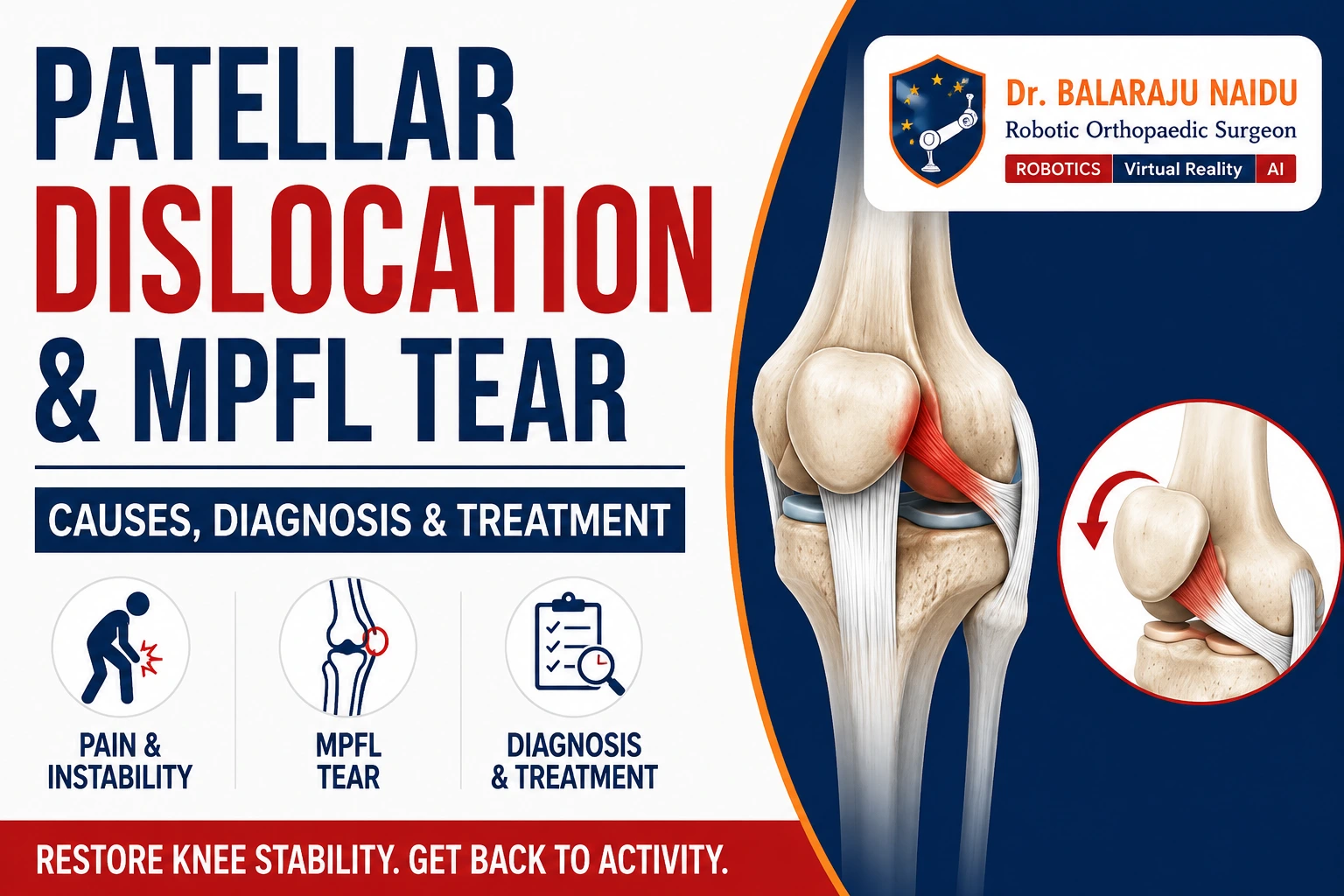
In many cases, recurrent patellar dislocation is associated with injury or tearing of the Medial Patellofemoral Ligament (MPFL), an important stabilizing ligament that helps keep the kneecap aligned within the groove of the femur.
In this article, Dr. Balaraju Naidu, Senior Robotic Orthopedic Surgeon at ONUS Robotic Hospitals, explains the causes, symptoms, diagnosis, and treatment options for patellar dislocation and MPFL tears.
What is Patellar Dislocation?
The patella, commonly known as the kneecap, sits within a groove at the front of the thigh bone (femur). It moves up and down smoothly as the knee bends and straightens.
A patellar dislocation occurs when the kneecap slips out of this groove, usually toward the outer side of the knee.
This can happen suddenly following an injury or repeatedly in individuals with underlying knee instability.
What is the MPFL (Medial Patellofemoral Ligament)?
The MPFL is a strong ligament located on the inner side of the knee.
Its primary function is to:
- Prevent the kneecap from moving excessively outward
- Maintain proper patellar alignment
- Provide stability during knee movement
- Protect the knee joint during walking and sports activities
When the kneecap dislocates, the MPFL is often stretched, partially torn, or completely torn.
Causes of Patellar Dislocation
Several factors can contribute to patellar instability and dislocation.
Traumatic Injury
A sudden twist of the knee during:
- Sports activities
- Running
- Jumping
- Falls
- Road traffic accidents
can force the kneecap out of position.
Anatomical Abnormalities
Some individuals naturally have:
- Shallow femoral grooves
- Misaligned kneecaps
- Knock knees (Genu Valgum)
- Increased ligament laxity
which increase the risk of recurrent dislocation.
Previous Patellar Dislocation
Once the kneecap dislocates, the risk of future episodes increases significantly, especially if the MPFL is damaged.
Symptoms of Patellar Dislocation and MPFL Tear
Symptoms may vary depending on the severity of the injury.
Common signs include:
Immediate Symptoms
- Sudden severe knee pain
- Visible kneecap displacement
- Swelling around the knee
- Difficulty bearing weight
Long-Term Symptoms
- Repeated kneecap slipping
- Feeling of instability
- Knee giving way while walking
- Difficulty climbing stairs
- Difficulty squatting
- Difficulty sitting cross-legged
- Clicking or catching sensation
- Fear of knee movement
Patients often describe a feeling that the knee is “slipping out” during daily activities.
Why Does Recurrent Patellar Dislocation Occur?
Recurrent dislocation usually occurs because the structures responsible for stabilizing the kneecap become damaged.
Common reasons include:
- MPFL tear
- Weak thigh muscles
- Poor patellar tracking
- Abnormal knee anatomy
- Untreated first-time dislocation
Without proper treatment, repeated dislocations can cause further cartilage damage and early arthritis.
Importance of MRI Evaluation
While X-rays help identify bone alignment, MRI plays a crucial role in evaluating soft tissue injuries.
An MRI scan can identify:
- MPFL tears
- Cartilage injuries
- Bone bruising
- Associated ligament damage
- Anatomical abnormalities
MRI helps orthopedic surgeons plan the most appropriate treatment strategy.
How is Patellar Dislocation Diagnosed?
Diagnosis typically includes:
Clinical Examination
The orthopedic specialist evaluates:
- Knee alignment
- Patellar movement
- Swelling
- Joint stability
- Range of motion
Imaging Studies
X-Rays
Used to assess:
- Patellar alignment
- Bone injuries
- Joint abnormalities
MRI Scan
Provides detailed assessment of:
- MPFL integrity
- Cartilage damage
- Soft tissue injuries
Conservative (Non-Surgical) Treatment
Not all patients require surgery.
Conservative treatment may be appropriate for:
- First-time dislocations
- Mild instability
- Partial MPFL injuries
- Patients without significant anatomical abnormalities
Treatment Options
- Rest
- Ice therapy
- Knee bracing
- Anti-inflammatory medications
- Physiotherapy
- Quadriceps strengthening exercises
- Activity modification
Physical therapy plays a key role in improving muscle control and patellar stability.
When is Surgery Required?
Surgical treatment may be recommended when:
- Patellar dislocation occurs repeatedly
- MRI confirms a significant MPFL tear
- Conservative treatment fails
- Severe instability affects daily activities
- Cartilage damage is present
The goal is to restore knee stability and prevent future dislocations.
Minimally Invasive MPFL Reconstruction
Modern orthopedic surgery allows stabilization of the kneecap through minimally invasive procedures.
What is MPFL Reconstruction?
MPFL reconstruction involves:
- Rebuilding the damaged ligament
- Restoring patellar stability
- Improving knee function
- Reducing the risk of recurrent dislocation
A tendon graft is used to recreate the torn ligament and secure the kneecap in its proper position.
Benefits
- Smaller incisions
- Less pain
- Faster recovery
- Improved knee stability
- Reduced recurrence risk
- Better return to sports and daily activities
Recovery After MPFL Surgery
Recovery varies depending on the severity of injury and individual patient factors.
Typical rehabilitation includes:
Early Phase
- Controlled knee movement
- Swelling reduction
- Pain management
Rehabilitation Phase
- Strengthening exercises
- Balance training
- Range-of-motion exercises
Return to Activity
Most patients gradually return to:
- Daily activities
- Walking
- Sports participation
- Exercise routines
under the guidance of their orthopedic surgeon and physiotherapist.
Can Patellar Dislocation Be Prevented?
While not all cases can be prevented, risk can be reduced through:
- Regular strengthening exercises
- Proper sports training
- Weight management
- Early treatment of knee injuries
- Following rehabilitation programs after dislocation
When Should You Consult an Orthopedic Surgeon?
Seek medical attention if you experience:
- Kneecap slipping repeatedly
- Knee instability
- Persistent knee pain
- Difficulty walking
- Swelling after a knee injury
- Sudden knee locking
- Fear of movement due to instability
Early diagnosis can help prevent long-term complications and joint damage.
Conclusion
Patellar dislocation and MPFL tears are common causes of knee instability, especially among active individuals and athletes. Ignoring repeated kneecap dislocations can lead to ongoing pain, cartilage damage, and reduced quality of life.
With proper diagnosis, MRI evaluation, physiotherapy, and advanced minimally invasive surgical techniques when needed, patients can achieve excellent outcomes and return to normal activities with confidence.
If you are experiencing recurrent kneecap dislocation or knee instability, consult an orthopedic specialist for a comprehensive evaluation and personalized treatment plan.
For Appointments:
Dr. Balaraju Naidu, Robotic Orthopedic Surgeon
ONUS Robotic Hospitals – Hyderabad