Terrible Triad of Elbow: Causes, Symptoms, Surgery & Recovery- By Dr. Balaraju Naidu, Robotic Orthopedic Surgeon, ONUS Robotic Hospitals
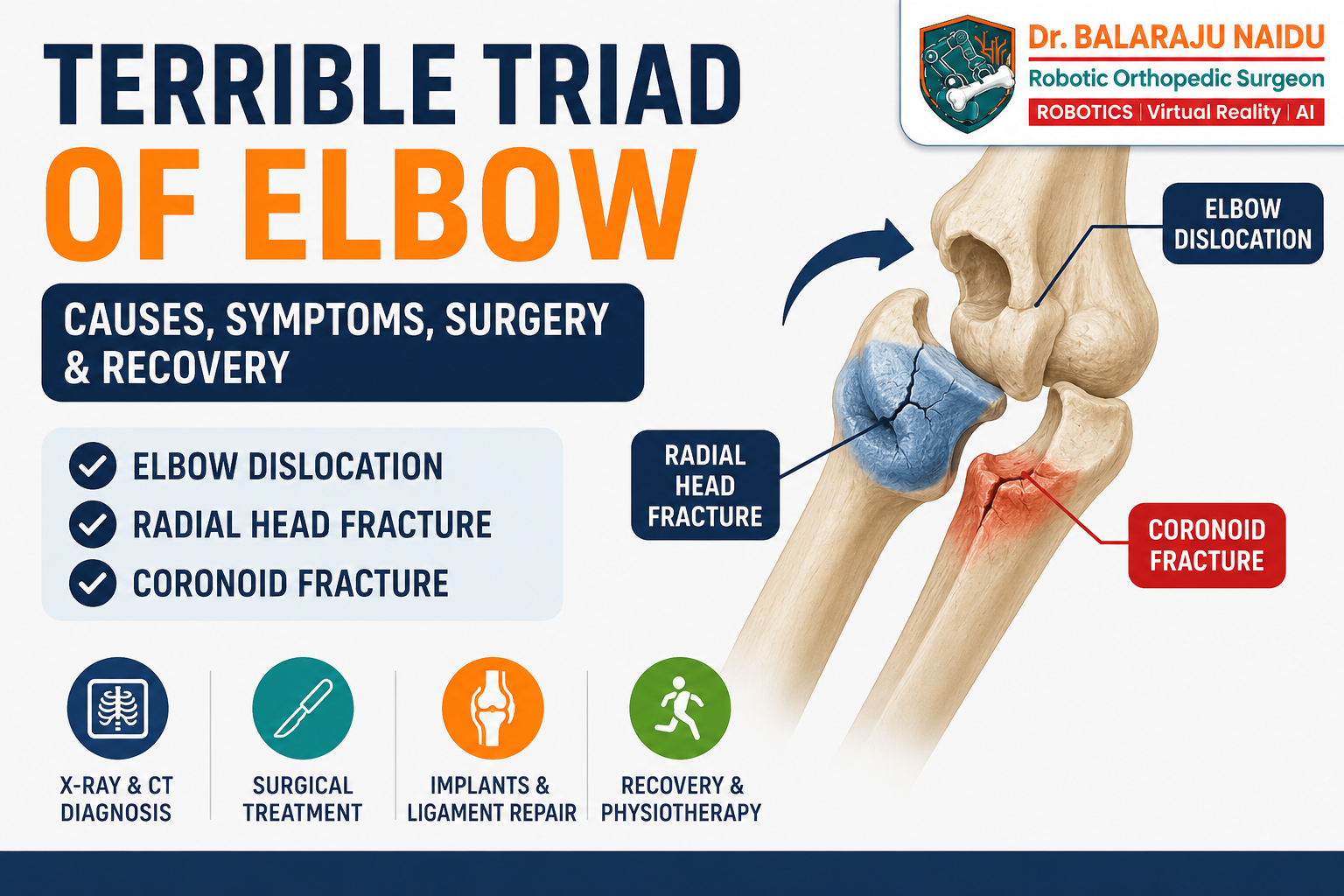
The Terrible Triad of Elbow is considered one of the most severe and unstable elbow injuries in orthopedic trauma care. This injury involves a combination of:
✔ Elbow Dislocation
✔ Radial Head Fracture
✔ Coronoid Process Fracture
Because three major stabilizing structures of the elbow are damaged together, this condition can lead to long-term stiffness, instability, arthritis, and loss of arm function if not treated properly and early.
At ONUS Robotic Hospitals, Dr. Balaraju Naidu and the orthopedic trauma team provide advanced surgical treatment and rehabilitation for complex elbow injuries using modern implants, ligament reconstruction techniques, and physiotherapy protocols.
What is the Terrible Triad of Elbow?
The elbow joint is stabilized by bones, ligaments, cartilage, and muscles working together. In a Terrible Triad injury:
- The elbow joint gets dislocated
- The radial head bone fractures
- The coronoid process of the ulna fractures
This combination creates a highly unstable elbow joint that usually requires surgical stabilization.
Orthopedic surgeons consider this injury “terrible” because it has a high risk of complications and poor functional outcomes if not managed correctly.
Common Causes of Terrible Triad Injury
This injury usually occurs due to high-energy trauma such as:
✔ Fall on an Outstretched Hand
A sudden fall with body weight transmitted through the arm can force the elbow out of position.
✔ Road Traffic Accidents
Bike accidents and high-speed trauma commonly produce this injury pattern.
✔ Sports Injuries
Contact sports, gym injuries, or falls during athletic activities may cause severe elbow trauma.
✔ Workplace or Industrial Injuries
Heavy impact injuries can damage multiple elbow stabilizers simultaneously.
Symptoms You Should Not Ignore
Patients with Terrible Triad injuries usually experience severe symptoms immediately after trauma.
Common Symptoms Include:
👉 Severe elbow pain
👉 Swelling around the elbow
👉 Visible deformity
👉 Inability to move the elbow
👉 Feeling of instability
👉 Clicking or locking sensation
👉 Numbness or tingling in fingers
👉 Severe stiffness after injury
If untreated, patients may develop chronic instability and permanent restriction of elbow movement.
Why is This Injury Dangerous?
The elbow is one of the most complex joints in the body. When multiple stabilizing structures are damaged together:
- The elbow becomes unstable
- Joint congruity is lost
- Movement becomes painful
- Risk of arthritis increases
- Stiffness develops rapidly
Delayed treatment can make surgery more difficult and reduce long-term functional recovery.
Diagnosis of Terrible Triad of Elbow
Early and accurate diagnosis is critical.
Clinical Examination
Doctors assess:
- Elbow stability
- Swelling and deformity
- Nerve function
- Range of motion
- Blood circulation
Imaging Tests
✔ X-Ray
Helps identify:
- Elbow dislocation
- Radial head fracture
- Coronoid fracture
✔ CT Scan
A CT scan provides detailed 3D assessment of fracture patterns and helps in surgical planning.
✔ MRI (In Selected Cases)
Used to evaluate ligament injuries and soft tissue damage.
Treatment Options for Terrible Triad of Elbow
Non-Surgical Treatment
Very few patients are suitable for conservative treatment. Mild stable injuries without major displacement may be treated with:
- Splints
- Bracing
- Pain medications
- Physiotherapy
However, most Terrible Triad injuries require surgery.
Surgical Treatment for Terrible Triad of Elbow
The main goal of surgery is to restore elbow stability and movement.
Surgical Procedures May Include:
✔ Radial Head Fixation or Replacement
If the radial head is severely shattered:
- Metal radial head replacement implants may be used
- This restores stability and allows movement
✔ Coronoid Fracture Fixation
Small screws or sutures may be used to repair the coronoid process.
✔ Ligament Repair & Reconstruction
Damaged ligaments are repaired to stabilize the elbow joint.
✔ Elbow Stabilization
Temporary external fixation may sometimes be required in severe instability.
Radial Head Replacement Implants
In severe fractures where the radial head cannot be repaired:
- Artificial metal implants are inserted
- These implants help restore elbow mechanics
- They improve stability and early motion
Modern implants provide better functional outcomes and reduce long-term complications.
Possible Complications
Despite advanced treatment, complications may occur if rehabilitation is delayed.
Potential Complications Include:
⚠ Elbow stiffness
⚠ Chronic instability
⚠ Post-traumatic arthritis
⚠ Implant loosening
⚠ Heterotopic ossification (extra bone formation)
⚠ Nerve irritation
⚠ Reduced range of motion
Early physiotherapy significantly improves recovery outcomes.
Recovery & Physiotherapy
Recovery after Terrible Triad surgery requires a structured rehabilitation program.
Recovery Timeline
First 2 Weeks
- Pain and swelling control
- Splint support
- Wound care
2–6 Weeks
- Gentle supervised movements
- Elbow mobilization exercises
6–12 Weeks
- Strengthening exercises
- Improved range of motion
3–6 Months
- Functional recovery
- Return to routine activities
Some patients may require prolonged physiotherapy depending on injury severity.
When Should You Consult an Orthopedic Surgeon?
Seek immediate medical attention if you experience:
✔ Severe elbow pain after a fall or accident
✔ Swelling with deformity
✔ Inability to move the elbow
✔ Numbness in fingers
✔ Feeling that the elbow is “out of place”
Early surgery often results in better movement and fewer complications.
Expert Elbow Trauma Care at ONUS Robotic Hospitals
Dr. Balaraju Naidu and the orthopedic trauma team at ONUS Robotic Hospitals specialize in:
✔ Complex elbow trauma surgery
✔ Radial head replacement
✔ Ligament reconstruction
✔ Sports injury treatment
✔ Advanced fracture care
✔ Rehabilitation & physiotherapy
For Appointments:
Dr. Balaraju Naidu, Robotic Orthopedic Surgeon
ONUS Robotic Hospitals – Hyderabad